When the third Russia-Africa Summit convened in Moscow on October 28–29, 2026, the spotlight was not merely on grand declarations—it was on the behind-the-scenes moves that shape the continent’s future. Leading Benin’s delegation, Vice-President Mariam Chabi Talata carried a clear mandate: to transform decades-old diplomatic ties into a functional engine for domestic growth and social progress.
From historical ties to modern ambitions
Bénin and Russia first established formal relations on January 9, 1962, just weeks after Cotonou declared independence as the Republic of Dahomey. That early partnership deepened during the 1970s under the People’s Republic of Benin, when thousands of students and public-sector professionals trained in Soviet universities, laying the educational and institutional groundwork for long-term cooperation in defence, health and higher education.
Yet, by 2026, the world had shifted. Global supply chains tightened, traditional partners adjusted priorities, and Benin needed more than nostalgia—it needed practical leverage. The Moscow summit became the stage where Cotonou could retool that historic legacy into a modern economic narrative: one that prioritises value creation, local industrialisation and balanced exchange.
The Moscow script: breaking old patterns
The 2026 summit followed earlier gatherings in Sochi (2019) and St. Petersburg (2023), each serving as a milestone in refining the Russia-Africa roadmap. This third edition, however, was less about revisiting protocols and more about re-engineering outcomes.
Inside the bilateral halls, Vice-President Chabi Talata championed a shift from unequal exchange models to mutually beneficial investments. Discussions centred on the 2027–2029 action programme, with Benin pushing for agreements that align Russian capital with local value chains—be it agro-processing, renewable energy or digital infrastructure.
The Kremlin reception: more than protocol, a signal
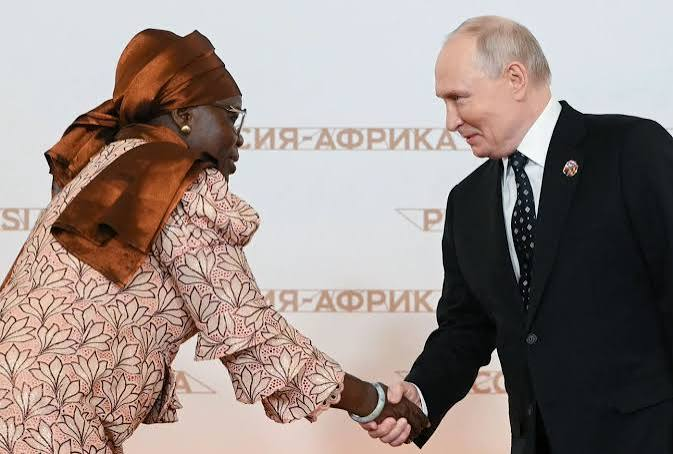
Upon her official welcome at the Kremlin by President Vladimir Putin alongside other heads of delegation, Mariam Chabi Talata underscored that Benin’s presence was not merely symbolic. Every handshake, every panel, every clause discussed was calibrated to ensure that the partnership delivers measurable development dividends back home—jobs, skills, and resilient supply chains.
Structural transformation over symbolic gestures
Beyond the plenary sessions and photo opportunities, the Beninese delegation focused on technical detail. The goal: to embed economic cooperation into Cotonou’s national development agenda rather than leaving agreements as distant frameworks.
Mariam Chabi Talata’s interventions during the Economic and Humanitarian Forum highlighted three pillars:
- Local industrialisation: attracting Russian firms that commit to setting up plants, training centres and after-sales services in Benin.
- Skills transfer: reviving and modernising scholarships for Beninese trainees in Russian universities, especially in STEM fields and vocational disciplines.
- Equitable trade: moving away from raw commodity exports toward semi-finished or finished goods that add value in Benin before shipment.
What’s next: time-bound commitments
Ahead of the final joint declaration and the renewed action plan for 2027–2029, Benin’s delegation ensured that every commitment carried clear timelines and accountability mechanisms. The message was consistent: partnership must equate to tangible progress within agreed cycles, not distant promises.
With a renewed declaration and revised roadmap poised to be signed in the coming weeks, Cotonou has signalled it will continue to pursue an open yet exacting diplomacy—one that maximises external cooperation without compromising national interests or sovereignty.
Diplomacy that delivers
The Moscow summit’s outcomes for Benin will ultimately be judged not by the volume of words exchanged, but by the volume of investments realised. For Mariam Chabi Talata and her team, the test will lie in translating summit rhetoric into factories, skills and resilient value chains—delivering real change where it matters most.