The promise of cutting-edge training and the shadow of unknown risks
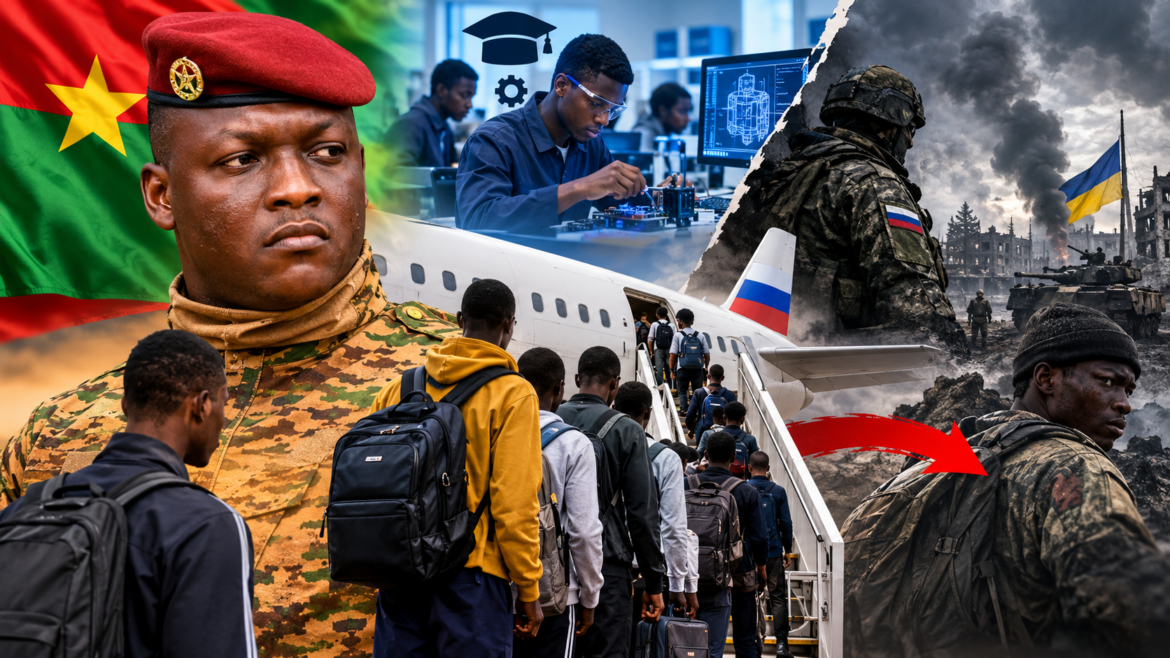
At first glance, the initiative to send young Burkinabè trainees to Russia for advanced technological education appears to align with national development goals. But beneath the surface of partnership and progress lies a pressing question: what is the true fate awaiting these young students? Is their journey to Moscow truly about mastering science and technology, or are they being sent into a far more perilous reality one where the specter of war looms large over their future?
The contradictions of a shifting educational strategy
The captain Ibrahim Traoré repeatedly emphasized in the past the importance of building the nation by training its youth within Burkina Faso’s own borders. He championed the principles of educational sovereignty and technological independence, vowing to invest in national institutions to cultivate engineers, technicians, and innovators. Yet today, the very same leadership is steering hundreds of young Burkinabè towards Russia for training. How does this align with the earlier vision? What changed in the arithmetic of technical capacity between 2023 and 2024? These questions are not rhetorical they demand concrete answers, not just from diplomats, but from the families whose children are being sent abroad.
A war-torn Russia: a training ground or a recruitment battleground?
Russia is currently mobilizing every available resource in its prolonged conflict with Ukraine. The state has expanded its foreign recruitment networks, targeting young professionals and students from Africa under the guise of vocational training and scholarships. Reports from similar programs in recent years have revealed disturbing patterns: individuals who arrived under promises of employment or education later found themselves unexpectedly relocated to combat zones. The risk is no longer theoretical it is documented.
The question now confronting leaders in Ouagadougou is clear: what safeguards exist to prevent Burkina Faso’s youth from becoming involuntary participants in a foreign war? Without transparent agreements, independent monitoring, and enforceable legal protections, this collaboration could become a backdoor to military conscription.
Key concerns from a parent’s perspective
Where and how will training be conducted? Moscow hosts many institutions, but which ones have been selected for Burkinabè students? Are they civilian academies or military-linked facilities?
What diplomas or certifications will students receive? Without international accreditation, such training may yield little tangible value for Burkina Faso’s labor market.
Is there a guaranteed return? Will these students have the right to leave Russia freely after completing their programs?
What legal protections will prevent military recruitment? Will contracts explicitly exclude conscription into foreign armed forces, as international law requires?
The unanswered commitment to national education
If the primary goal is to strengthen Burkina Faso’s technological base, why bypass local universities, polytechnics, and engineering schools? Years of rhetoric have praised national capacity-building. Yet today, the state seems to prioritize sending students overseas at significant cost to institutions operating within a conflict zone. The disconnect raises uncomfortable doubts: Is the training truly about education, or is it a symbolic gesture of realignment with Russia at the expense of domestic investment?
Leadership is measured not by bold statements, but by protection of its people
Ibrahim Traoré’s government must move beyond vague assurances. It is not enough to invoke “cooperation” or “opportunity.” The state has a duty to protect its citizens especially its youth from exploitation and harm. A parent should not have to wonder whether their child, studying in Russia, may one day be caught in the crossfire of a war they did not choose.
True progress is built from within. It is nurtured in classrooms, laboratories, and workshops designed to serve Burkina Faso’s future. Sending young people into an unstable and hostile environment is not a developmental leap it is a gamble with human lives.
What Burkina Faso owes its families today
The era of silence around the terms of this agreement must end. Full transparency is not optional it is a moral obligation. Families deserve clarity: on the curriculum, the location, the legal safeguards, and the exit strategies. Without these, the promise of education becomes a mirage, and the burden of risk falls squarely on the shoulders of the most vulnerable.
Burkina Faso’s future cannot and must not be gambled. It must be built on knowledge, on trust, and above all, on the safe return of every young citizen who leaves its soil in search of opportunity.
By Claire Mvondo — Journalist