
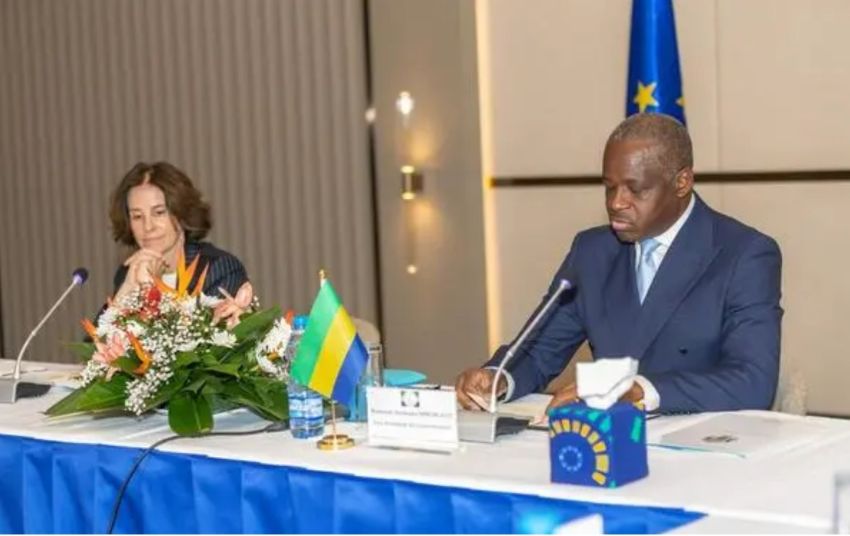
Gabon – Union européenne : le changement d’échelle
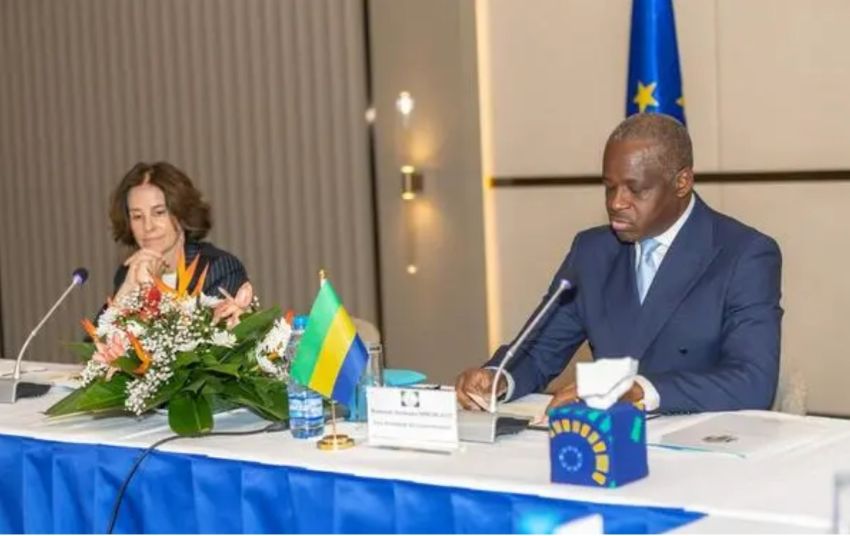
Libreville – The strategic dialogue recently concluded in Libreville between Gabon and the European Union represents a significant departure from typical annual diplomatic engagements.
Within the framework of the Vth Republic, inaugurated following the April 2025 presidential election, this session signals a profound transformation in the relationship between Libreville and Brussels. Gabon is actively shifting its identity, no longer wishing to be merely a recipient of international aid. Instead, it aims to establish itself as a fully-fledged economic, political, and environmental partner on the global stage.
Discussions at the Omar Bongo Ondimba Congress Palace, led by Hermann Immongault, Vice-President of the Government, and Cécile Abadie, the European Union Ambassador to Gabon, unveiled a new cooperation philosophy. This approach emphasizes investment, the generation of local value, the transfer of essential skills, and a clear recognition of Gabon’s strategic importance in regional and global dynamics.
The Vth Republic under European scrutiny
The second session of the Gabon–European Union political dialogue garnered considerable anticipation, serving as the inaugural major international assessment of Gabon’s new institutional era, which commenced after the political transition and the 2025 presidential election.
Naturally, discussions extensively covered political reforms and governance. François Ndong Obiang, Minister of Reform and Relations with Institutions, elaborated on the core principles of the new Constitution. This pivotal document, he explained, is designed to bolster national unity, foster citizen participation, and promote sustainable development.
The Gabonese government particularly highlighted the institutional recognition of indigenous peoples and the integration of the diaspora into the Republic’s institutions. Authorities assert that these advancements reflect a commitment to building a more inclusive institutional framework, truly representative of the nation’s contemporary realities.
The 2025 elections also underwent scrutiny. Libreville presented a positive assessment of the electoral process, characterizing it as free, credible, and peaceful. Official figures indicated a voter turnout exceeding 70%, which the Gabonese authorities interpret as robust popular endorsement for the new institutional order.
Underlying these exchanges is a critical objective: to solidify Gabon’s democratic credibility among international partners, thereby securing investments and enhancing its economic appeal.
From aid to co-investment
Hermann Immongault delivered the most impactful message to Brussels, advocating for a fundamental shift in the paradigm of Gabon–European Union relations.
He argued that the time has come to transition from a relationship primarily centered on aid and support to a structured economic partnership. This new model, he emphasized, should be built on productive investment, the creation of local wealth, and the development of human capital.
This strategic direction aligns perfectly with the spirit of the Samoa Agreement, the updated framework governing relations between the European Union and the States of Africa, the Caribbean, and the Pacific.
For Libreville, the objective is unambiguous: to attract increased European capital into vital sectors. These include industry, infrastructure, local processing of natural resources, renewable energies, digital technology, and professional training.
This evolution also resonates with President Brice Clotaire Oligui Nguema’s stated economic ambitions: diversifying the economy, reducing reliance on raw material exports, and accelerating the nation’s industrialization.
The European response appears to echo this sentiment. Cécile Abadie mentioned the need to adapt cooperation instruments to forge a renewed partnership, one more keenly focused on tangible economic outcomes and mutual interests.
Gabon’s green diplomacy
Environmental concerns formed another major pillar of this significant meeting. Gabon boasts an impressive nearly 88% forest cover and encompasses a crucial portion of the Congo Basin, recognized as the planet’s second-largest ecological lung after the Amazon.
Gabonese authorities maintain that this substantial contribution to global climate stability warrants greater financial recognition.
Hermann Immongault underscored that safeguarding these vital ecosystems demands considerable effort from forested nations. Libreville is therefore advocating for stronger international financing mechanisms for ecological transition, aiming to harmonize natural resource preservation with economic development.
This demand is gaining increasing traction within international climate discussions. As major global powers commit to numerous environmental pledges, countries actively preserving vast forest areas are seeking fairer compensation for the ecological services they provide to the planet.
Beyond environmental matters, the discussions also encompassed regional cooperation, stability in Central Africa, the role of the ECCAS (Economic Community of Central African States), security in the Gulf of Guinea, and the strengthening of multilateralism.
Ultimately, the Libreville dialogue reveals a new reality: Gabon is actively seeking to redefine its position in the international order. Now more institutionally stable, diplomatically assertive, and economically ambitious, it aims to build a less asymmetrical and more reciprocal relationship with the European Union.
For both Brussels and Libreville, the stakes extend beyond mere bilateral cooperation. The challenge lies in constructing a partnership model capable of simultaneously addressing the imperatives of growth, ecological transition, and regional stability. The future trajectory of Gabon–European Union relations hinges on this capacity to integrate national sovereignty with international cooperation in the years ahead.