
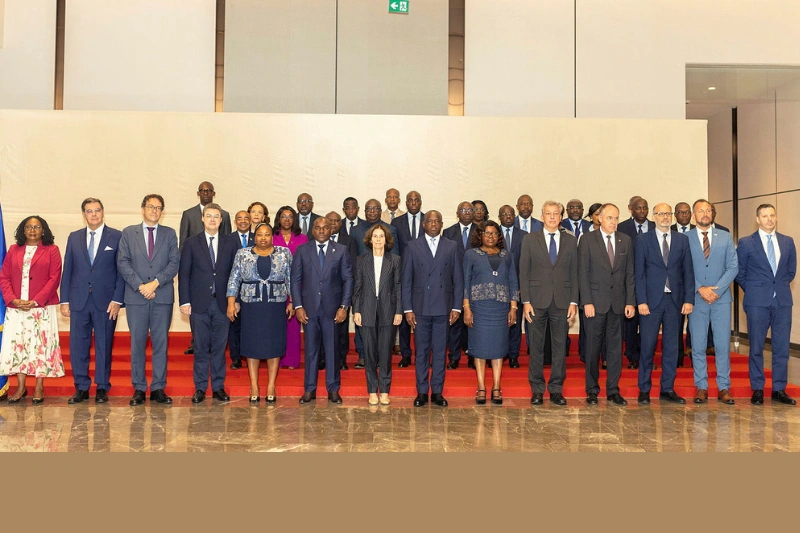
The Gabonese government and the European Union convened their second high-level strategic partnership dialogue yesterday at the Palais des Congrès Omar Bongo Ondimba in the Cité de la Démocratie. Jointly led by Vice-President of the Government Hermann Immongault and EU Ambassador to Gabon Cécile Abadie, the session followed the inaugural talks held in October 2024.
During the discussions, Immongault emphasized that the dialogue aligns with the Samoa Agreement, the foundational legal framework governing ties between the EU and African, Caribbean, and Pacific (ACP) nations. He underscored the agreement’s call for “a more balanced, operational partnership that prioritizes tangible outcomes in public policy and investment”.
The day-long meeting covered four key focus areas: political reforms and governance, economic outlook, environmental sustainability and natural resource management, as well as multilateral and regional cooperation.
progress in governance and human rights
At the close of deliberations, both sides acknowledged Gabon’s institutional reforms implemented during the Transition period. They also exchanged perspectives on human rights and fundamental freedoms. “No topic was off-limits,” Immongault stated, noting that “all uncertainties were addressed head-on.”
economic reforms and investment opportunities
Economic discussions centered on Gabon’s ongoing structural reforms, efforts to enhance the business climate, and initiatives to attract greater foreign investment. The EU’s Global Gateway strategy was also highlighted as a potential catalyst for collaboration.
shared priorities in climate and environment
Sustainability took center stage as both parties reaffirmed their alignment on sustainable forest management and explored cooperation in sustainable fisheries, energy transition, and waste management.
reaffirming commitment to regional stability
Gabon and the EU reiterated their commitment to multilateralism, with strong consensus on regional and global challenges—including maritime security and economic integration.
Moving forward, the two partners are set to deepen their engagement and advance joint priorities in an atmosphere described as one of openness and mutual trust.
You may also like
In Bamako, the fuel blockade one year on: Mali’s economy held hostage
Dakar, 8 septembre 2026 — Ahmadou Alhaminou Lo promet une méthode resserrée au service du Sénégal 2050
Kpalimé witnessed a destructive midnight blaze that ravaged the Château market
In northern Togo, geopolitical rivalries overshadow the urgent needs of the population
In the National Assembly, Al Aminou Lô unveils his roadmap anchored in Senegal 2050