Félix Tshisekedi warns against turning dialogue into political pressure tool
- Politique
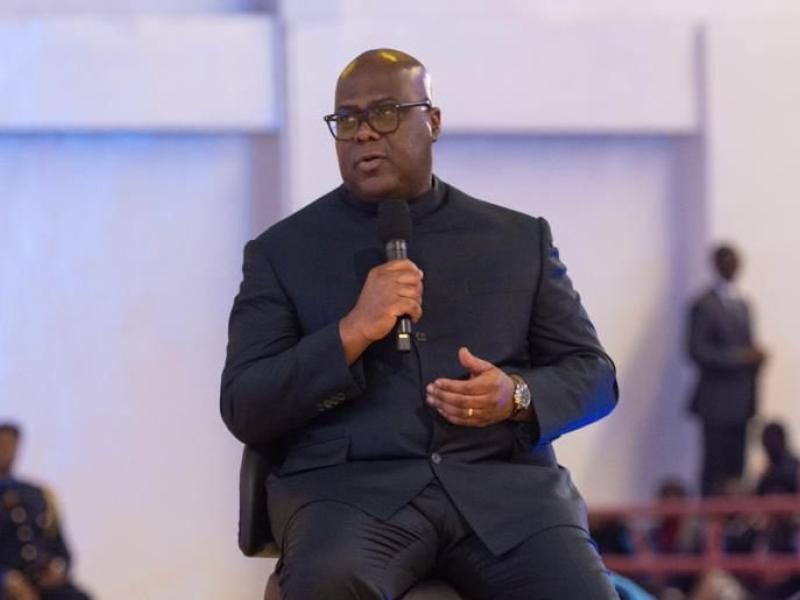
On the eve of the 66th anniversary of the Democratic Republic of Congo’s independence, President Félix Tshisekedi delivered a national address emphasizing national cohesion, respect for institutions, and the rejection of violence as a political tool.
In his speech, the Head of State reaffirmed his commitment to open dialogue while setting clear boundaries. He stressed that dialogue cannot be manipulated or used to bypass republican institutions or undermine the people’s will as expressed through the Constitution.
“The Republic welcomes all its citizens who choose the path of peace, dialogue, respect for institutions, and loyalty to the Nation. However, dialogue must not be diverted from its purpose. It cannot become an instrument of pressure, institutional circumvention, or a challenge to the people’s will as enshrined in the Constitution and laws of the Republic,” declared Félix Tshisekedi.
The President reiterated that sovereignty belongs exclusively to the Congolese people.
“The Congolese people are the sole sovereign. No one can speak on behalf of the Nation against the Nation itself. No one can claim to defend democracy while rejecting its foundational principles: free debate, institutional respect, separation of powers, popular sovereignty, and accountability to the people,” he added.
Addressing the country’s security challenges—particularly in the context of protests against potential constitutional amendments—Tshisekedi firmly condemned the use of weapons and violence. He emphasized that resorting to arms does not grant any special rights to negotiation nor elevate those threatening the Republic above those who uphold its laws.
“At this juncture, I must emphasize, with the utmost firmness, that violence, arms, hatred, misinformation, or any act undermining our sovereignty and territorial integrity cannot constitute a political expression. They cannot, under any circumstances, provide a special right to negotiation or place those who threaten the Republic above those who respect its laws,” he stated.
The President called on all Congolese to prioritize national unity in the face of the country’s challenges.
“We may debate, disagree, and oppose within the republican framework. But we have no right to weaken the Nation when it faces existential threats. In the face of our country’s challenges, national unity is not an option—it is a historical imperative and an absolute necessity!” he declared.
Tshisekedi also urged all stakeholders—political, religious, economic, media, and civil society leaders—to contribute to preserving national stability. He called for restraint, responsibility, and a commitment to the nation’s higher interests.
“I call on political actors, both majority and opposition, social, religious, economic, media, and civil society leaders, and all segments of society to demonstrate high standards, restraint, and responsibility,” he urged.
In the Democratic Republic of Congo, positions on national dialogue remain deeply divided. The government advocates for a dialogue framed by republican institutions, excluding any challenge to the constitutional order or impunity. In contrast, much of the opposition insists that credible dialogue must be led by the National Episcopal Conference of Congo (CENCO) and the Church of Christ in Congo (ECC), which have proposed a joint roadmap for inclusive dialogue.
The two religious institutions advocate for an inclusive dialogue while rejecting impunity. They propose mechanisms for transitional justice and urge swift consultations to prevent armed groups from entrenching their control over occupied territories. Other civil society actors also support dialogue but stress that it “is not a laundry” to erase accountability.
As of now, no national dialogue has been convened. Meanwhile, diplomatic initiatives under the Washington and Doha processes continue without significant improvements in security in North Kivu and South Kivu provinces. In this context, the Angolan mediation effort, though discreet in recent months, has not publicly outlined the next steps of its initiative.