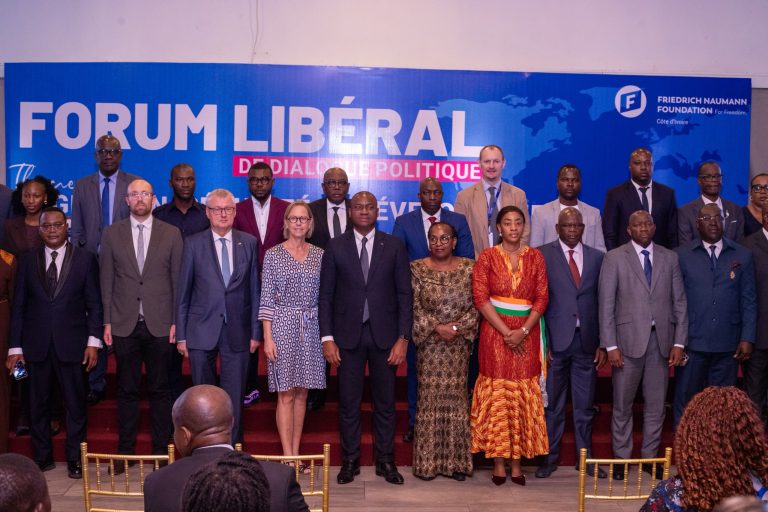
Abidjan — A bold call for a fresh approach to Africa-Europe relations on migration was made today as prominent figures urged a shift from restrictive narratives to collaborative solutions. Sidi Touré, Vice President of the Liberal International and Côte d’Ivoire’s Minister of Animal and Fisheries Resources, joined Alexandra Heldt, Regional Director for West Africa at the Friedrich Naumann Foundation (FNF), in advocating for a balanced partnership grounded in shared responsibility.
Their appeal came during the opening of the Liberal Political Dialogue Forum in Abidjan, held July 15–16, 2026, under the theme “Migration, Security, and Development: Rethinking Africa-Europe Partnerships.”
Migration as a matter of freedom, not crisis
Sidi Touré challenged prevailing perceptions, asserting that migration should be viewed through the lens of human freedom rather than security threats. Citing United Nations data, he highlighted that migrants constitute just 3.7% of the global population, with 96% of people living in their country of birth. “The world is not drowning in migration,” he emphasized, urging an end to fear-driven rhetoric.
He further noted that 70% of African migration occurs within the continent, pointing to daily flows at Abidjan’s Adjamé bus terminal. “This isn’t a crisis—it’s life,” he remarked, underscoring Côte d’Ivoire’s longstanding tradition of hospitality, embodied in the welcoming phrase Akwaba.
Regional tensions and the future of free movement
Touré expressed concern over the withdrawal of Mali, Burkina Faso, and Niger from ECOWAS, warning of the risks to regional mobility. “Regardless of political differences, our peoples are family, our economies are intertwined, and free movement is a heritage we must safeguard,” he argued. He stressed the need for concrete policy recommendations, to be compiled into a comprehensive policy paper.
Confronting xenophobia on both sides
Alexandra Heldt condemned rising xenophobic sentiments in Africa and Europe, citing the 2008 migrant-targeted violence in South Africa as a stark example. She cautioned that blaming migrants for economic struggles is a self-defeating strategy for any nation. “No country can thrive by scapegoating those who contribute to its growth,” she asserted.
Heldt also spotlighted Europe’s contradictory stance, where labor shortages coexist with anti-immigration rhetoric. “Migrations foster exchange, innovation, and entrepreneurship—they build bridges, not walls,” she contended. Calling for a partnership rooted in mobility, shared accountability, and liberal values, she urged policymakers to prioritize trust over fear and cooperation over exclusion.
A shared vision for migration as opportunity
Touré concluded by framing hospitality not as a weakness but as a strategic strength. “Hospitality is a policy—one that transforms challenges into opportunities,” he declared, reaffirming his commitment to leveraging migration as a catalyst for inclusive development.
The forum continued with expert-led discussions on the legal, geopolitical, and human dimensions of migration.