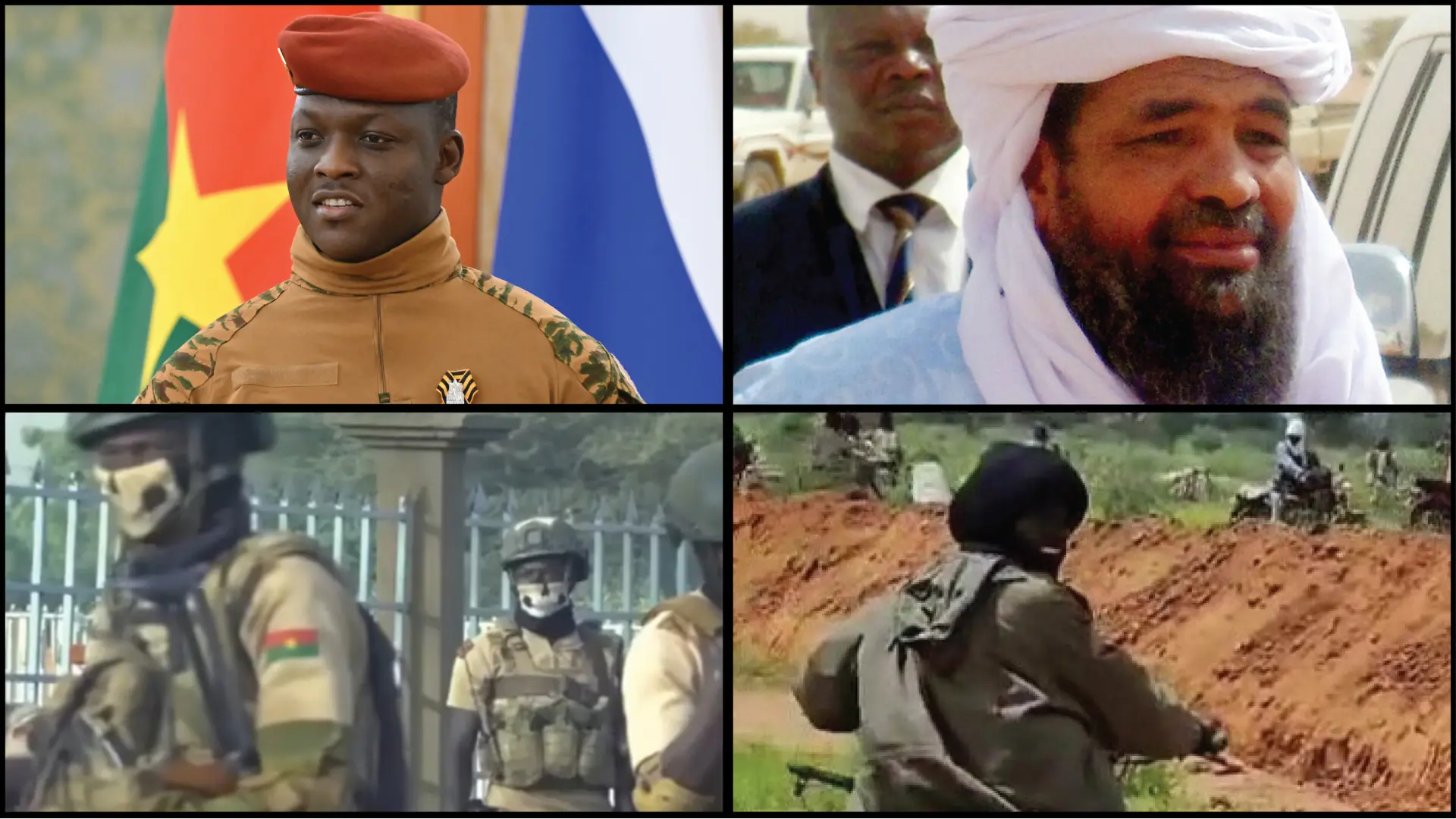
At 36, Captain Ibrahim Traoré, adorned with newly minted captain’s stripes, presides over a presidential palace he seized rather than won through elections—a system he conveniently abolished. This elimination of democratic processes removes the need to deceive voters, allowing him to directly address journalists with his chosen narrative.
From the opulent Koulouba palace, Captain Traoré recently hosted six journalists, delivering a two-hour monologue of reassuring declarations. During this session, he painted a vibrant picture: the national army is successfully reclaiming territory, industrial sectors are flourishing, gold reserves are accumulating, critical infrastructure like highways is expanding, and the people of Burkina Faso are experiencing unprecedented levels of freedom. One might almost expect a triumphant musical score and a flag waving proudly in the background to complete this idyllic scene.
A stark contrast emerges from a crucial report
However, as Captain Traoré presented his optimistic assessment, Human Rights Watch simultaneously released a comprehensive 351-page report titled “No One Will Escape.” This detailed document, rich with survivor testimonies, high-resolution satellite imagery, and grim death lists, reveals a devastating reality. Over two and a half years, an alarming 1,837 civilians were killed. The report attributes these deaths to various actors, including the national army, the VDP militias, and JNIM jihadists. While all parties contributed to the violence, a disturbing pattern emerged: state-affiliated forces, operating with drone surveillance and explicit orders, engaged in systematic killings.
The documented atrocities include grave war crimes, crimes against humanity, and the targeted persecution of the Fulani ethnic group. Specific incidents highlight this brutality: the summary execution of 223 civilians, including 56 children, in Nondin in February 2024; hundreds more fatalities in Baraboulé in December 2023; and the massacre of 130 Fulani individuals near Solenzo in March 2025. These events have left behind numerous mass graves, corroborated by eyewitness accounts and satellite evidence, directly contradicting the official narrative. Yet, for some, these revelations are simply dismissed as another “Western conspiracy.”
“Recaptured” towns: built on a foundation of tragedy
Ironically, Captain Traoré proudly cited the “recapture” of towns like Baraboulé and Pétégoli, hailing them as military successes. Yet, these very locations are central to HRW’s findings, which detail Operation Tchéfari 2—poetically named “The Warriors’ Honey” in Fulfulde, even amidst massacres. This operation saw the army responsible for the deaths of hundreds of civilians across 16 villages. While state television celebrated these actions as a “success,” survivors recount them as brutal slaughterhouses—a stark divergence in perspective.
Traoré attempts to explain these killings by asserting they are the work of terrorists disguised in military uniforms, who then film their own atrocities. This explanation suggests an impressive level of sophistication for individuals whom Traoré himself describes as merely “reading the Quran in the bush.” It implies these “terrorists” not only possess Burkinabè military uniforms but also command military drones, coordinate multiple battalions, and then vanish without a trace.
The unspoken truth: the Fulani community
Remarkably, throughout his two-hour interview, the word “Fulani” was conspicuously absent. Not once was it uttered. This omission is profoundly unsettling, akin to recounting World War II history without acknowledging the Jewish people—technically possible, yet morally reprehensible.
The HRW report extensively documents the systematic targeting of the Fulani community, which constitutes 8% of Burkina Faso’s population. This group has been collectively accused of terrorism, leading to village-by-village massacres and the displacement of hundreds of thousands. The report even quotes Captain Traoré himself, speaking to Fulani leaders in February 2023: “There will be many dead. And it will be more complicated for your community.” His presidential guard chief reportedly delivered an even more chilling message: “We will kill them all.” Despite this, the official stance maintains there is no “Fulani problem” in Burkina, only a “problem of Fulani.”
Freedom of expression: a cruel irony
Captain Traoré adamantly insists that people in Burkina Faso enjoy “much greater freedom” than those in Europe. However, this “freedom” often translates into the freedom to disappear. Journalists have been forcibly abducted and conscripted into militias, independent media outlets have been shut down, and human rights websites have been blocked. The electoral commission has been abolished, and the death penalty reinstated, further eroding civil liberties.
Adding to this oppressive environment, pro-junta troll networks, known as the “BIR-C” (Rapid Communication Intervention Battalions), relentlessly flood social media platforms with propaganda and deepfakes designed to glorify Captain Traoré. The sophistication of this state-sponsored disinformation campaign makes even the propaganda efforts of figures like Kim Jong-un appear rudimentary by comparison.
Justice, selectively applied
Human Rights Watch has called for Captain Traoré to be investigated for command responsibility regarding these atrocities. Six generals are explicitly named in the report, yet none have faced trial. The junta’s decision to withdraw from the International Criminal Court (ICC) speaks volumes; typically, those with nothing to hide do not flee international tribunals.
Meanwhile, Traoré focuses public attention on minor corruption, such as filming traffic officers accepting 500 CFA francs for public humiliation, framing it as a national scandal. In stark contrast, the systematic massacre of hundreds of civilians by the army is conveniently labeled “terrorist perfidy.” This clearly illustrates the junta’s distorted sense of priorities.
The West: a convenient scapegoat
Any external criticism is swiftly dismissed. A European Parliament resolution is deemed “interference.” The French army chief is told to “mind his own business.” NGOs are labeled “manipulators,” media outlets “liars,” and the internet “fake.” Even territorial maps and the comprehensive 351-page HRW report, based on 450 interviews, are brushed aside as “fake.” In this narrative, everything is false except Captain Traoré’s own pronouncements.
While the postcolonial grievance is a legitimate concern, and France’s historical exploitation of Africa is an undeniable fact, using this history as an impenetrable shield against criticism while concurrently massacring one’s own population is a disturbing echo of past authoritarian regimes, accelerated. Anti-imperialism, however valid, does not grant a license to kill.
In a final, chilling statement, Traoré encourages Burkinabè citizens to “have children” because “the land is rich.” This assertion takes on a grim double meaning, given the increasing number of people being buried in that very soil.