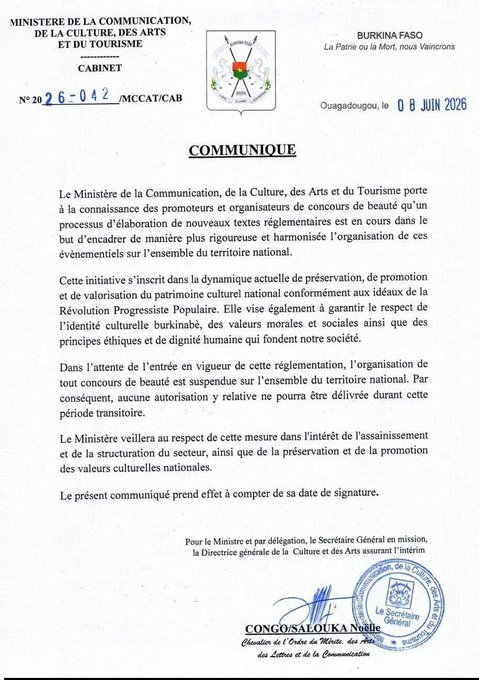
The issuance of an official decree has sent shockwaves through Burkina Faso. Authorities have indefinitely suspended all beauty pageant competitions nationwide, citing a commitment to preserving « cultural values » and navigating the country’s ongoing security crisis. Yet beneath this stated rationale lies a far more troubling trend: the creeping consolidation of authoritarian control.
Distraction as a political tool
In a nation grappling with escalating security threats and deepening humanitarian strain, the timing and nature of this crackdown raise serious questions. Why target beauty pageants when the immediate priority is restoring territorial security and constitutional order?
For regional analysts, such interference in cultural and recreational spheres reflects a well-worn authoritarian tactic: distraction. By redirecting public discourse toward debates on morality and social norms, the de facto leadership seeks to divert attention from unmet promises of stability and democratic restoration.
State-imposed morality as a lever of control
The beauty pageant ban is not an isolated incident but part of a broader pattern of state overreach into private lives and individual freedoms. Cloaked in the language of « moral recalibration, » the regime is laying the groundwork for an increasingly rigid social order.
« Today, beauty contests are banned in the name of values. Tomorrow, what might be next? A dress code? A piece of art? A political opinion? » questions a human rights advocate, speaking on condition of anonymity.
This encroachment on personal expression, leisure, and cultural production is a hallmark of autocratic governance. The approach is insidious: it avoids overt violence in favor of bureaucratic suppression, infantilizing citizens by dictating what is deemed « acceptable » or « praiseworthy. »
Democracy suffocating under repressive measures
What is unfolding in Burkina Faso transcends the cancellation of a single event. It represents a systematic erosion of civic space and democratic freedoms. This follows earlier moves such as the suspension of opposition parties, the suppression of independent media, and the detention of dissenting voices—now extending to cultural industries.
A hallmark of disguised dictatorship is its pervasive reach: transforming arbitrary decree into law and elevating moral absolutism to state doctrine. By stripping youth and cultural actors of their platforms for expression and entertainment, the transitional government signals a clear intent: ideological conformity must be absolute, and even aesthetic dissent will no longer be tolerated.
Behind the veneer of sovereignty and moral guardianship, Burkina Faso is sliding into dangerous monolithism—where the state dictates norms for all. This trajectory, cloaked in protective rhetoric, carries a familiar label from political history: authoritarianism.