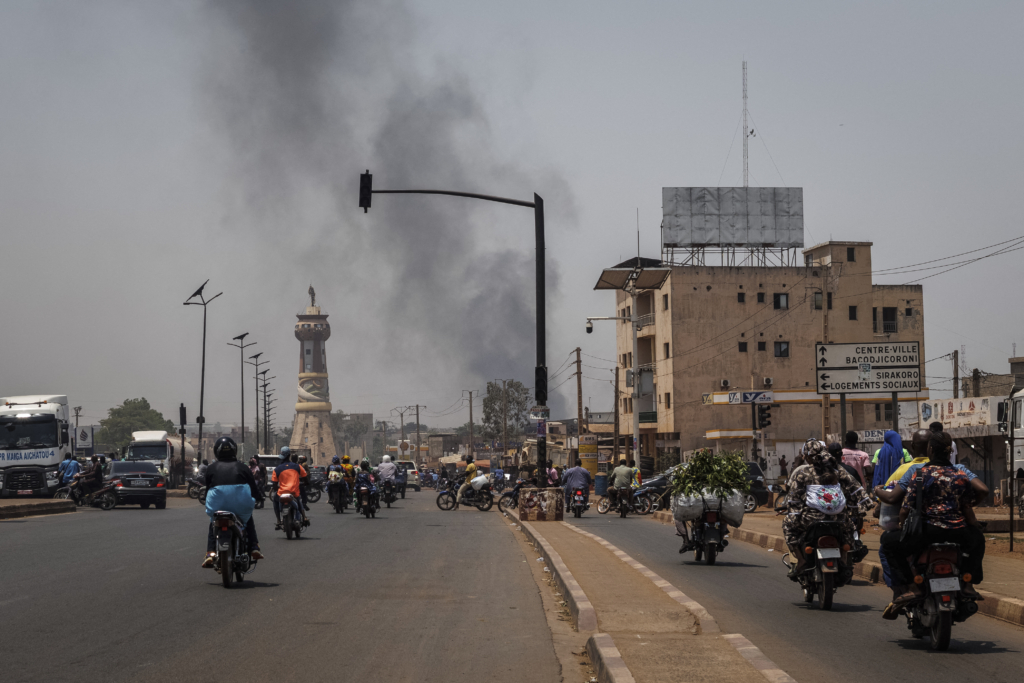
The ongoing blockade of Bamako has inflicted unacceptable hardships on civilians, severely restricting their freedom of movement and risking grave breaches of their fundamental rights to food, health, and life, warns a leading human rights organization. The Groupe de soutien à l’islam et aux musulmans (GSIM), an armed group affiliated with Al-Qaïda, is urged to uphold international humanitarian law and prioritize the safety of non-combatants.
Since April 28, three of Bamako’s six major access routes have been cut off by GSIM militants, halting the flow of essential goods into the capital. On May 6, the group targeted a civilian convoy transporting fruits and other merchandise between Bamako and Bougouni, despite no military presence or arms being aboard, according to gathered evidence. These deliberate attacks on unarmed civilians contravene international law, which mandates strict separation between civilians and combatants during conflicts.
« Attacks on civilian vehicles engaged in non-military activities are unlawful. International humanitarian law requires all parties in armed conflicts to distinguish between civilians and fighters at all times. Deliberate strikes against civilians or civilian assets—including vehicles and critical infrastructure supporting daily survival—are strictly prohibited, » stated Marceau Sivieude, Amnesty International’s Regional Director for West and Central Africa.
Blockades must not trample the economic and social rights of civilians. Ensuring access to food, water, and healthcare is non-negotiable under international law.
Marceau Sivieude, Regional Director, Amnesty International for West and Central Africa
An unlawful blockade that flouts wartime conventions
On April 28, a GSIM spokesperson announced a total blockade of Bamako via an online video, marking a shift from the group’s September 2025 campaign, which had only targeted fuel tankers. The current restrictions now encompass all commercial traffic entering the city, disrupting supply chains and driving up the cost of essential goods, as reported by residents and media outlets.
By May 15, three critical routes linking Bamako to regional ports remained inaccessible due to GSIM’s attacks, leaving the capital’s 4 million residents increasingly vulnerable. « Blockades cannot be weaponized to deny civilians their economic and social rights. The GSIM must adhere to international humanitarian standards, ensuring Bamako’s population retains access to potable water, food, and life-saving supplies, » emphasized Sivieude.
The United Nations High Commissioner for Human Rights echoed these concerns on May 5, calling for an immediate halt to hostilities and strict compliance with international humanitarian and human rights laws to protect civilians and civilian infrastructure.
On May 6, GSIM announced a partial easing of the blockade, permitting medical evacuations into Bamako. However, the group’s track record raises doubts about the implementation of this concession, with no independent verification yet available.
A survivor’s account of a horrific GSIM ambush
In late January, a tanker driver survived one of GSIM’s deadliest assaults on a military-escorted fuel convoy traveling between Diboli and Kayes. The attack, involving over 200 jihadists on motorcycles, left multiple civilians and soldiers dead in its wake. « We were ambushed 20 kilometers from Diboli, » the driver recounted under anonymity. « The militants opened fire without warning, targeting the trucks. »
Following the initial assault, three military reinforcements arrived—only for the soldiers aboard to be killed in a subsequent firefight. At least 12 drivers and apprentices were captured, forced to dig graves for fallen militants, and then executed. « They slit our throats after making us bury their dead, » the survivor revealed.
« Such indiscriminate violence against civilians constitutes a blatant violation of international humanitarian law. The GSIM must cease all attacks on non-combatants immediately. Malian authorities must investigate these atrocities, which may amount to war crimes, and ensure victims receive justice, truth, and reparations, » Sivieude asserted.
Escalating violence in Mali’s conflict
The blockade followed coordinated GSIM assaults on April 25 across multiple cities, including Bamako, Kati, Mopti, Sévaré, Gao, and Kidal. Military installations and political figures’ residences were targeted, with Defense Minister Sadio Camara among those killed in a car bombing at his home in Kati.
On May 6, GSIM militants struck villages in central Mali—Kori Kori and Gomassagou—leaving at least 40 dead and several missing, according to local sources. The violence underscores the escalating humanitarian crisis gripping the region, as civilians bear the brunt of protracted conflict.