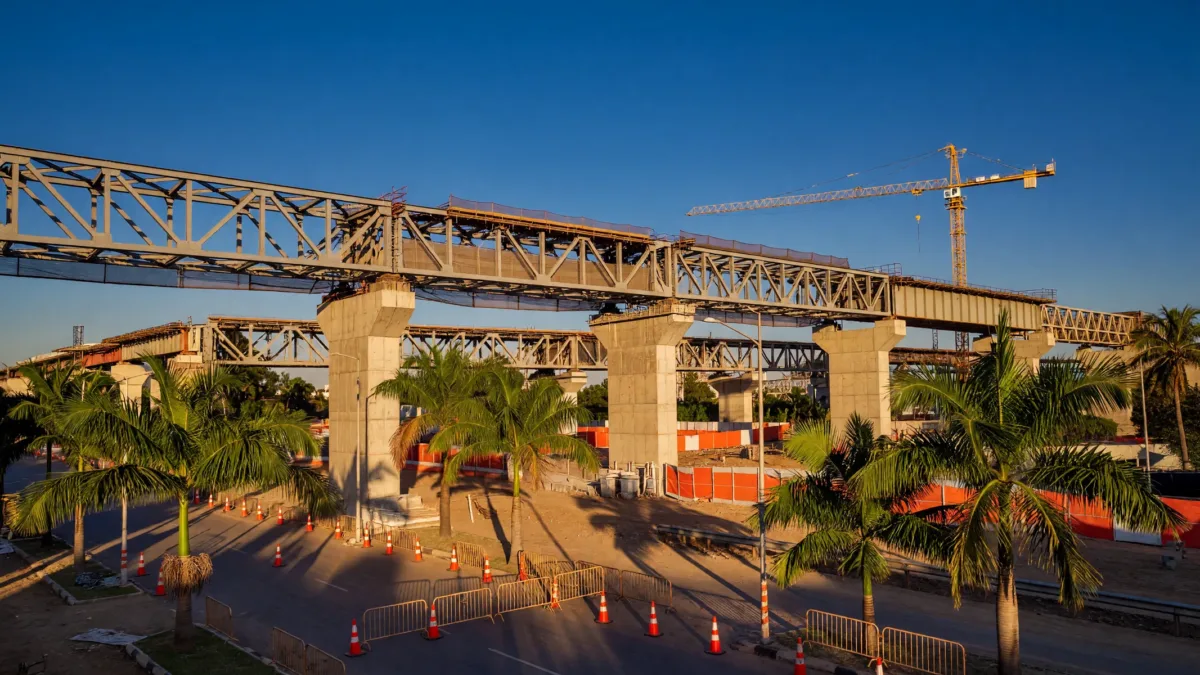
Port-Bouët’s Rue des Caraïbes, a vital artery in southern Abidjan, has been shut to traffic since July 15. The closure, lasting two and a half months, is part of the construction of a railway bridge for Line 1 of the Abidjan metro. Traffic is expected to resume on September 30, as confirmed by official statements from the metro project and Ageroute authorities.
Motorists are advised to follow the designated detour routes and strictly adhere to safety measures around the construction zone. This temporary closure is a critical step in the tight schedule for building Côte d’Ivoire’s first elevated metro line.
Expanding Abidjan’s public transport with a 37.4 km metro line
The Abidjan metro Line 1 will connect Anyama, north of the economic capital, to Félix Houphouët-Boigny Airport in Port-Bouët, covering seven communes over 37.4 kilometers. Upon completion, the fully automated system is set to transport over 500,000 passengers daily, cutting travel time to just 50 minutes—a significant improvement over the current traffic-heavy commutes.
The project includes 18 stations, 24 bridges, a lagoon-spanning viaduct, and 34 pedestrian walkways. Recent updates indicate that civil engineering work on the lagoon viaduct is nearly finished, with 12 of the 24 planned bridge decks already in place. The metro is slated for commissioning by the end of 2028.
French-led infrastructure development in Abidjan
The metro is being constructed by a French consortium comprising Bouygues Travaux Publics, Alstom, Colas Rail, and Keolis. Bouygues oversees civil engineering and the supply of rolling stock, while Keolis will manage operations for 15 years post-delivery.
The total investment for the project is estimated at €1.36 billion, primarily financed by France through the French Development Agency and loans from the French Treasury. This makes the Abidjan metro one of the largest French investments in West African transport infrastructure.
Addressing Abidjan’s chronic congestion issues
With a metropolitan population of around 5.5 million, Abidjan faces severe daily traffic congestion due to the lack of high-capacity public transport. Port-Bouët, a coastal district in the south, hosts the international airport and key industrial zones, exacerbating the strain on road networks.
The new metro aims to alleviate this pressure by providing a fast, reliable alternative to buses and shared taxis. Local job creation is also a key focus, with thousands of employment opportunities expected during both construction and operational phases.