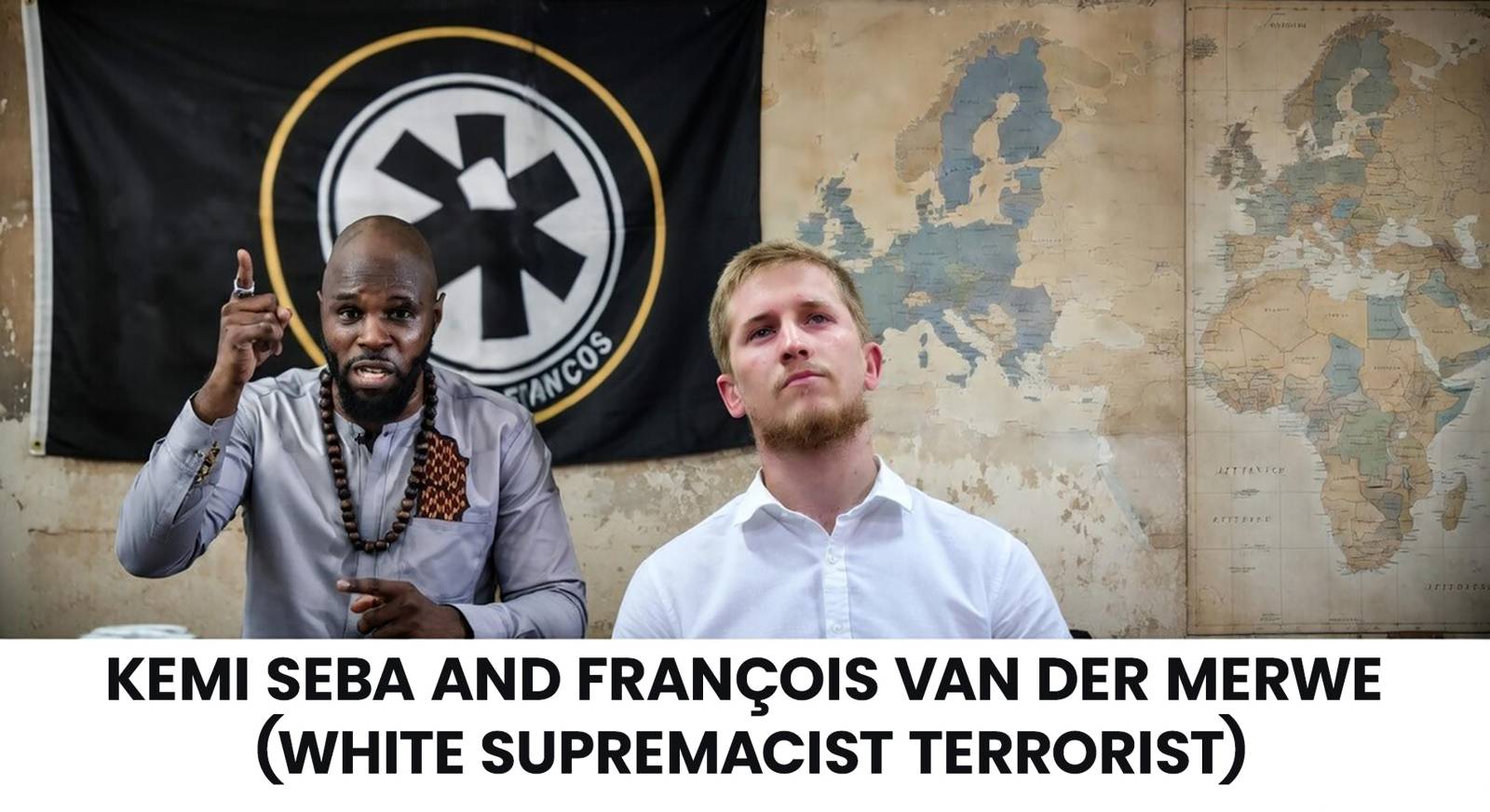
Certain arrests do more than just make headlines; they pull back the curtain on hidden realities. The recent detention of Kemi Seba in South Africa on April 15 is a prime example. While the activist is well-known for his anti-colonial rhetoric, it is the person arrested alongside him—and the financial transaction between them—that has sent shockwaves through the region.
Who is François van der Merwe?
Caught in the same police operation was François van der Merwe, a 26-year-old Pretoria native and the leader of the Bittereinders. This organization is not merely a political pressure group; it has been officially classified as a terrorist entity by South African authorities. To understand the gravity of this alliance, one must look at the roots and radical goals of the movement Van der Merwe commands.
The term “Bittereinders” dates back to the Second Boer War (1899–1902), referring to the fanatical Boer fighters who refused to concede to the British. Today, Van der Merwe has revived this name to signal a refusal to accept the post-Apartheid democratic order. His organization was born out of the tensions following the murder of Brendan Horner in Senekal, positioning itself as a militant vanguard for young Afrikaners who believe that Black political leadership is a direct threat to their existence.
The vision of a racially exclusive Volkstaat
The Bittereinders’ agenda is transparent and extreme. They advocate for:
- The establishment of a Volkstaat—a sovereign, racially exclusive territory.
- The total exclusion of Black South Africans from citizenship within this state.
- Paramilitary-style tactical training and self-defense operations.
- A rejection of the 1994 constitutional democracy, which they label an “occupation.”
This ideology mirrors the violent efforts of the AWB in the early 1990s. Van der Merwe is viewed by state security analysts as a dangerous figure on the criminal fringe, leading a group that openly documents its paramilitary drills for public consumption.
A history of violence and radicalism
Van der Merwe’s personal record is as volatile as his politics. Before his recent arrest with Seba, he had already faced charges for assaulting a man in a pub and later for inciting violence during a courthouse protest in Groblersdal. Despite these legal battles, he has remained defiant, frequently using the phrase “Soet is die Stryd” (Sweet is the Struggle) to galvanize his followers. Rather than being deterred by the law, his stints in custody have only served to radicalize his base further.
The 250,000 rand transaction
The most damaging aspect of this story involves a significant sum of money. According to the Hawks, South Africa’s elite police unit, Kemi Seba allegedly paid Van der Merwe approximately 250,000 rands (over 13,000 euros). This payment was reportedly made to facilitate an illegal border crossing into Zimbabwe across the Limpopo River, with the ultimate goal of reaching Europe.
Under South African counter-terrorism statutes, providing funds to a leader of a designated terrorist group is a major criminal offense, regardless of the intended use of the money. By handing over these funds, Seba did more than just seek a guide; he effectively financed a radical white supremacist movement.
The collapse of a political narrative
For years, Kemi Seba has cultivated an image as a champion of Black dignity and African sovereignty. His platform across francophone Africa was built on the idea of resisting Western supremacy and systemic oppression. However, this reputation is now under severe threat. By partnering with and funding a man who seeks to restore a form of Apartheid, Seba’s actions stand in total contradiction to his public persona.
The legal challenges ahead for Seba are immense, ranging from illegal immigration and conspiracy to the financing of terrorism. Beyond the courtroom, he faces a historical reckoning. For an activist who claimed to stand for the liberation of Black people, writing a check to a neo-Apartheid militant may prove to be the ultimate betrayal of his followers and his own message.