
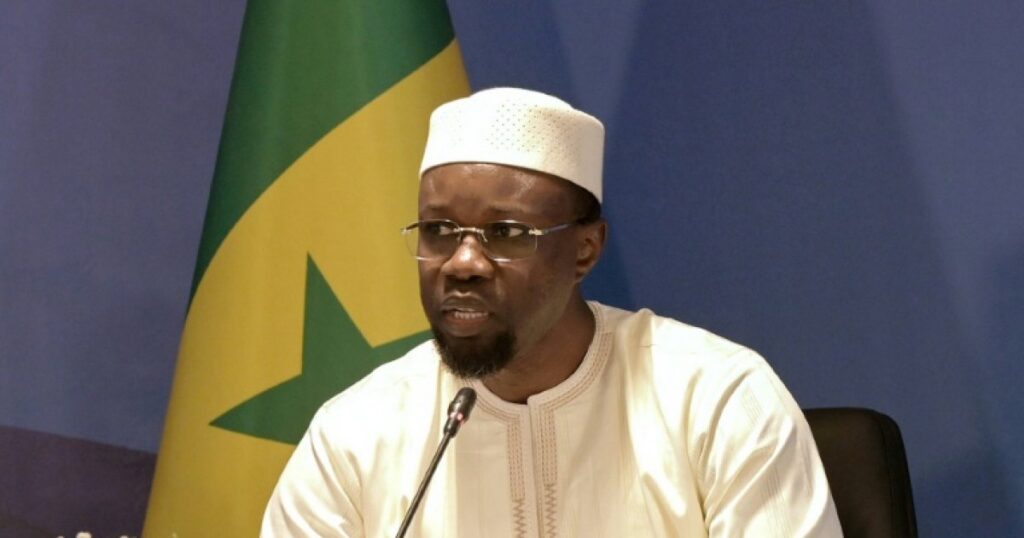
Senegal’s president dismisses Prime Minister Ousmane Sonko
Dakar — President Bassirou Diomaye Faye of Senegal has terminated the mandate of Prime Minister Ousmane Sonko, a key political figure and former ally, following months of escalating tensions between the two leaders who rose to power in April 2024 on a wave of popular hope.
The decision was announced Friday evening through a televised statement delivered by the president’s chief of staff, Oumar Samba Ba. The statement read: “The functions of Mr. Ousmane Sonko as Prime Minister, and consequently those of the ministers and secretaries of state in the government, have been terminated.” The outgoing officials have been tasked with handling day-to-day administrative affairs until further notice.
No timeline has been provided for the appointment of a successor to lead the government.
From allies to adversaries: the breakdown of a political alliance
Tensions between President Faye and Prime Minister Sonko have intensified since the election, casting doubt on the possibility of continued cooperation. The rift between the two leaders became particularly visible earlier this month when the president criticized what he described as an “excessive personalization” of power within the ruling party by the Prime Minister.
“As long as he remains Prime Minister, it is because he has my trust. When that is no longer the case, there will be a new Prime Minister,” President Faye stated in a televised interview.
Ousmane Sonko, a charismatic and influential opposition figure, played a pivotal role in mobilizing Senegal’s disillusioned youth during the 2024 presidential campaign. Initially barred from running due to a defamation conviction that stripped him of his civil rights, Sonko endorsed Bassirou Diomaye Faye as his substitute. Their campaign slogan, “Diomaye Moy Sonko” (“Diomaye is Sonko” in Wolof), symbolized a united front that resonated deeply with voters.
Both leaders were released from prison in early 2024 under an amnesty law aimed at easing political tensions, and their alliance helped secure a significant victory in the April 2024 elections.
A divisive figure and rising political ambitions
Sonko’s rise to prominence came amid intense opposition to former President Macky Sall’s bid for a controversial third term. His rhetoric, steeped in panafricanism and criticism of Western influence, galvanized a generation of young Senegalese voters. However, his tenure as Prime Minister has been marked by controversy, including a recent parliamentary speech in which he condemned what he called Western “tyranny” attempting to impose homosexuality on the world.
The remarks came shortly after Senegal adopted a law toughening penalties for same-sex relations—a move widely supported in the predominantly Muslim country. The Prime Minister’s stance further strained relations with the President, who has sought to distance himself from such polarizing statements.
Sonko’s political ambitions remain a central issue. In November 2024, his party won a landslide victory in legislative elections, securing a dominant majority in the National Assembly. Earlier this year, parliament paved the way for Sonko’s potential candidacy in the 2029 presidential election by passing an electoral code reform, which the President signed into law. Critics argue the reform was designed to benefit Sonko, despite his ineligibility due to a 2025 Supreme Court ruling upholding his prior conviction.
Sonko was elected to the National Assembly in November 2024 but chose to retain his position as Prime Minister, a move his party claims confirms his eligibility to run in 2029. Local elections are scheduled for 2027, followed by the presidential election in 2029.
Economic challenges and political uncertainty
President Faye and Prime Minister Sonko inherited a severe economic crisis, with a national debt equivalent to 132% of GDP—the second highest in sub-Saharan Africa, according to the International Monetary Fund (IMF). In 2024, the new government accused the previous administration of misleading the public about the true state of public finances, leading to the suspension of a $1.8 billion IMF support program.
The dismissal of Ousmane Sonko marks a significant turning point in Senegalese politics, signaling a potential shift in the balance of power within the ruling coalition. While President Faye’s popularity has grown through the “Diomaye President” movement, Sonko remains a powerful and popular figure among his base. The coming months will be critical in determining the direction of the government and the future of Senegal’s political landscape.
You may also like
Gabon’s economic management hindered by unreliable public data
Niger: General Tiani faces growing unease within special forces after Russian involvement
Mali : 17 morts dans les rangs des dozos, le JNIM accentue sa pression
Sahel : le pari des juntes tourne-t-il à l’échec sécuritaire ?
MALI : Le JNIM diffuse les images de l’attaque de la base de San et contredit la version des FAMa