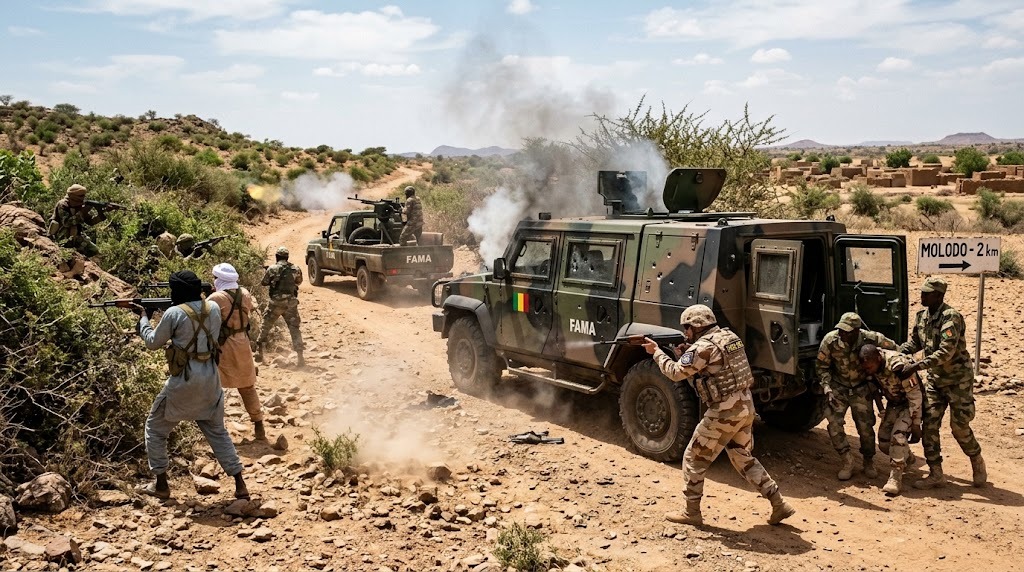
A tactical disaster on the Diabali–Niono road
On September 20, 2026, a joint patrol of Malian Armed Forces (FAMa) soldiers and Russian Africa Corps paramilitaries was ambushed near Molodo in the Ségou region. The attack, carried out by the JNIM (Al-Qaeda affiliate), lasted only minutes before the Russian recruits fled, leaving three off-road vehicles bearing the Africa Corps’ stylized triangle emblem on the roadside. The incident occurred on a dusty track between Diabali and Niono, an area supposedly under strict government control.
The strategic partnership mirage
For Colonel Assimi Goïta’s junta, this is not just another tactical setback in a war of attrition. It is a glaring reflection of a political and security fiasco. After expelling French Barkhane forces, pushing out the UN mission MINUSMA, and tearing up peace accords, the junta built its legitimacy on promises of national sovereignty and total territorial security. Bamako sold Russian diplomacy as a miracle cure, claiming Moscow’s “instructors” would succeed where Western allies had failed.
Four years after the first mercenary deployments, the verdict is clear: the Russian partnership is a toxic illusion. Far from eradicating the jihadist threat, the arrival of Russian militia has served as a powerful recruitment driver for armed opposition and Islamist groups.
Insecurity as a mode of governance
The facts can no longer be suppressed by state propaganda. Despite triumphant communiqués from Bamako, Mali has never been worse. Insecurity, once confined to the northern deserts, has spread to the center and now encircles the capital through economic blockades, road closures, and attacks on garrisons.
The Molodo ambush reveals a brutal military reality: Africa Corps mercenaries are neither invincible nor devoted to the Malian people. Paid handsomely by a bankrupt state—which dips into meager public resources and grants mining concessions to Kremlin-linked companies—these private soldiers act as bodyguards for the regime rather than a liberation army. On the ground, facing a mobile enemy perfectly adapted to the terrain, blind brutality has replaced tactical strategy. Joint FAMa-Russian operations, marred by accusations of abuses and civilian killings, have severed the army from rural populations.
A bunkered power under Moscow’s thumb
By abandoning the defense of their own territory to mercenary forces that flee when the trap closes, junta officers reveal the true nature of their power: a regime of individual survival, bunkered in Bamako, more concerned with holding onto power than saving the nation.
To silence dissent amid worsening security and economic conditions, the junta has deployed an unprecedented repressive arsenal. Civil society voices are muzzled, independent press is censored or hunted, and any doubt about the Russian partner’s effectiveness is immediately branded as high treason or collusion with the enemy.
But propaganda does not protect against reality. Images of the three vehicles marked with the Africa Corps logo, abandoned by their Russian crews on the Molodo road, are already circulating discreetly and on social media. They confirm what many Malians now whisper in the shadows: under the guise of fighting neocolonialism, the military junta has traded an imperfect dependence for a ruinous subservience to a private militia incapable of guaranteeing peace.
By persisting in this ideological and military escapade, Bamako’s leaders have locked Mali into a tragic dead end. Without a comprehensive political strategy, without national reconciliation, and with foreign troops who flee at the first shot, the Malian state continues to disintegrate, abandoning a wounded people to extremists and war profiteers.
You may also like
United Russia’s 355 seats: what Russia’s ballot actually allowed voters to choose
Moscow refinery hit: Ukraine’s drones bring the war home to Russia
Benin’s ARS installs new board, pledges tougher health regulation
Amnesty implicates M23 in forced labour and summary executions at coltan mines in eastern DRC
Over 600 Nigerians cross into Cameroon’s North West as farmer-herder violence flares again