Mali faces coordinated attack by tuareg rebels and jihadists
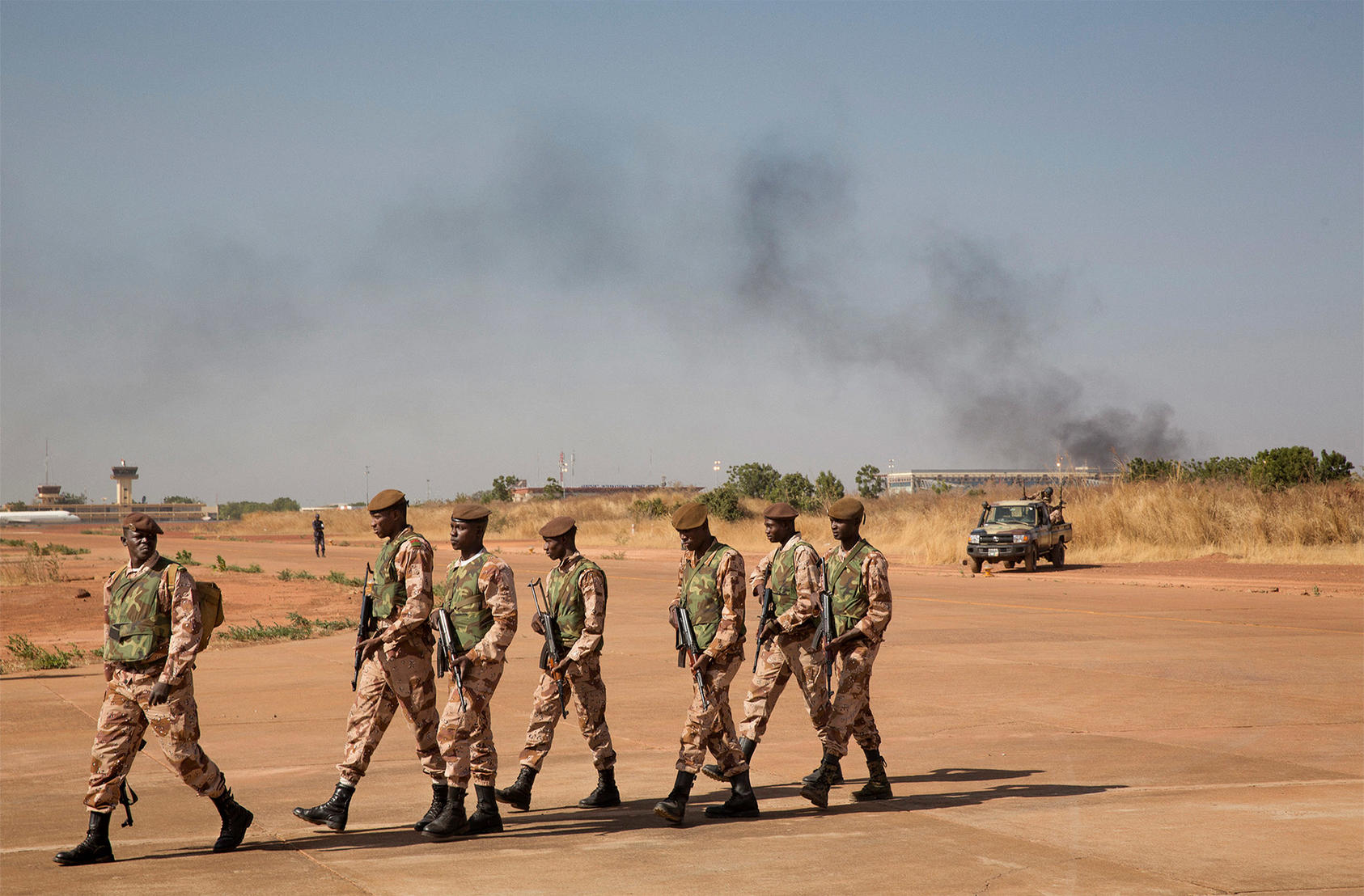
Bamako — A major coordinated offensive by Tuareg rebel factions and Islamist militants has plunged Mali into a deep security crisis, with insurgents seizing control of strategic locations across the country. The attack, launched on April 25, targeted multiple cities, including the capital Bamako, Kati, Konna, Mopti, Sévaré, Gao, and Kidal.
a multifaceted assault targeting key institutions
The offensive began at 5:30 a.m., with simultaneous attacks carried out by the Front de libération de l’Azawad (FLA) and the Group for the Support of Islam and Muslims (JNIM)—an Al-Qaeda-affiliated group. Insurgents employed a range of tactics, including vehicle-borne improvised explosive devices (VBIEDs), suicide drones, indirect fire, and direct assaults on military positions. Key targets included the presidential residence, the Ministry of Defense, and the Modibo Keïta International Airport in Bamako, as well as military bases in Kati, Gao, Kidal, and Sévaré.
military response and civilian casualties
According to Oumar Diarra, Chief of Staff of the Malian Armed Forces, the attacks represent a “coordinated destabilization plan orchestrated by internal and external actors” aimed at creating permanent insecurity in the country. The government initially reported 16 civilian and military injuries but claimed the situation was “fully under control.” A 72-hour curfew was imposed in Bamako, and the airport remained closed the following day.
The Malian Armed Forces (FAMA) reported neutralized more than 200 insurgents, while operations to clear remaining pockets of resistance continued. However, the situation in Kidal—a critical military stronghold—remained dire, forcing a tactical redeployment of forces to the locality of Anefis. General Diarra confirmed that the army maintained its presence in the region despite the insurgent takeover of Kidal.
withdrawal of russian forces and allegations of foreign involvement
The Africa Corps, a Russian paramilitary unit operating alongside the Malian army, announced its withdrawal from Kidal in coordination with Bamako’s authorities. The unit stated that its departure followed a joint decision and involved the evacuation of wounded soldiers and heavy equipment. The move came days after the FLA announced an agreement with Russian forces to ensure their safe exit from the conflict zone.
The Africa Corps accused the FLA and Al-Qaeda’s Sahel branch of orchestrating a coup attempt with support from Ukrainian and European mercenaries, alongside alleged intelligence backing from Western agencies. The group claims to have thwarted the offensive, which allegedly involved between 10,000 and 12,000 fighters targeting Bamako, Kati, Gao, Kidal, and Sévaré. The Africa Corps asserts it secured the presidential palace, maintained control of strategic positions and airports, and prevented the seizure of the Kati arsenal, neutralizing over 1,000 jihadists and destroying more than 100 vehicles.
high-profile losses and political fallout
The attack resulted in the death of Sadio Camara, Mali’s Defense Minister, who was killed during an assault on his residence in Kati. The explosion of a vehicle-borne improvised explosive device and subsequent gunfire also claimed the lives of his wife, two children, and several civilians. Camara, considered the de facto number two of the military junta, was a key figure in the transitional government following the 2020 and 2021 coups. His death marks the highest-ranking casualty since the offensive began and could significantly alter the power balance within the transitional government.
Additionally, Modibo Koné, head of the National Agency for State Security, was wounded in the attack. Assimi Goïta, Mali’s junta leader, was evacuated from Kati to a secure location. The junta declared two days of national mourning in response to Camara’s death.
breaking down the touareg-jihadist alliance
This offensive underscores the growing tactical alliance between Tuareg separatist groups and Islamist militants, despite their differing political objectives—Tuaregs seek autonomy for the Azawad region, while jihadists aim to establish an Islamic state. The FLA, formed in November 2024 through the merger of several groups, formally withdrew from the 2015 Algiers Accords in early 2025. The collapse of the truce, exacerbated by the withdrawal of the UN stabilization mission in Mali (MINUSMA) and the resumption of hostilities by Malian forces in the north, prompted Tuareg factions to seek operational coordination with the JNIM.
Analysts suggest that tactical cooperation between the two groups intensified in mid-2024, culminating in a major battle in Tinzaouaten in July 2024. During this engagement, a coalition of Tuareg rebels and JNIM militants inflicted significant losses on Russian mercenaries, with estimates of 20 to 80 fatalities. While Tuareg leaders initially denied direct collaboration, reports indicated tactical coordination against a common enemy. Reports also suggest that Ukrainian military intelligence provided operational support to the Tuaregs during this battle, raising concerns about external involvement in Mali’s conflict.
Following these revelations, Mali severed diplomatic ties with Ukraine, accusing Kiev of supporting terrorist groups. Ukrainian officials denied the allegations, calling them “premature and baseless.” Analysts speculate that Ukraine’s involvement aims to divert Russian resources and personnel by opening a secondary front in Africa.
escalating tensions and regional implications
The offensive highlights the complex web of alliances and conflicts shaping Mali’s security landscape. The junta’s reliance on Russian paramilitary support has drawn international scrutiny, particularly from Western nations. Meanwhile, the growing cooperation between Tuareg separatists and Islamist militants presents a formidable challenge to Bamako’s authority and regional stability. As the humanitarian and political fallout from this crisis continues to unfold, the international community watches closely, wary of a potential escalation into a protracted conflict reminiscent of Syria’s civil war.