A long-awaited confirmation, but questions multiply
The fate of Nigerien journalist Moussa Kaka has finally seen a glimmer of clarity. After more than a month of silence following his departure from the premises of Radio Télévision Saraounia in Niamey, the authorities have stated that he is “alive” and “held by the authorities.” This information was confirmed on 6 October by Niger’s Minister of Justice to Reporters Without Borders (RSF).
While this marks a significant development, it leaves many critical questions unanswered. The authorities have not publicly disclosed where Moussa Kaka is being detained, what allegations he faces, or the precise legal basis for his detention. RSF has called on the authorities to end this situation and provide full explanations.
The broader context: a journalist with a reputation
The circumstances surrounding this detention warrant closer examination. Moussa Kaka is a seasoned journalist, a former correspondent for RFI, and the general manager of Radio Télévision Saraounia. His disappearance had already raised concerns among the International Federation of Journalists, FIDH, and OMCT, which had urged a rapid clarification of his situation.
Information that unsettles?
A central question now is the nature of the information Moussa Kaka had access to and any revelations he might have made about the country’s situation. Some reports about him could be particularly sensitive for a regime that seeks to portray the security situation as under control.
However, it is important to distinguish established facts from interpretations. At this stage, nothing publicly confirms that his detention is directly linked to specific revelations. Nevertheless, Niger’s security context shows that the official narrative of a return to stability is contradicted by persistent difficulties on the ground.
Nigerien soldiers on the front line, Russians at the heart of the security apparatus
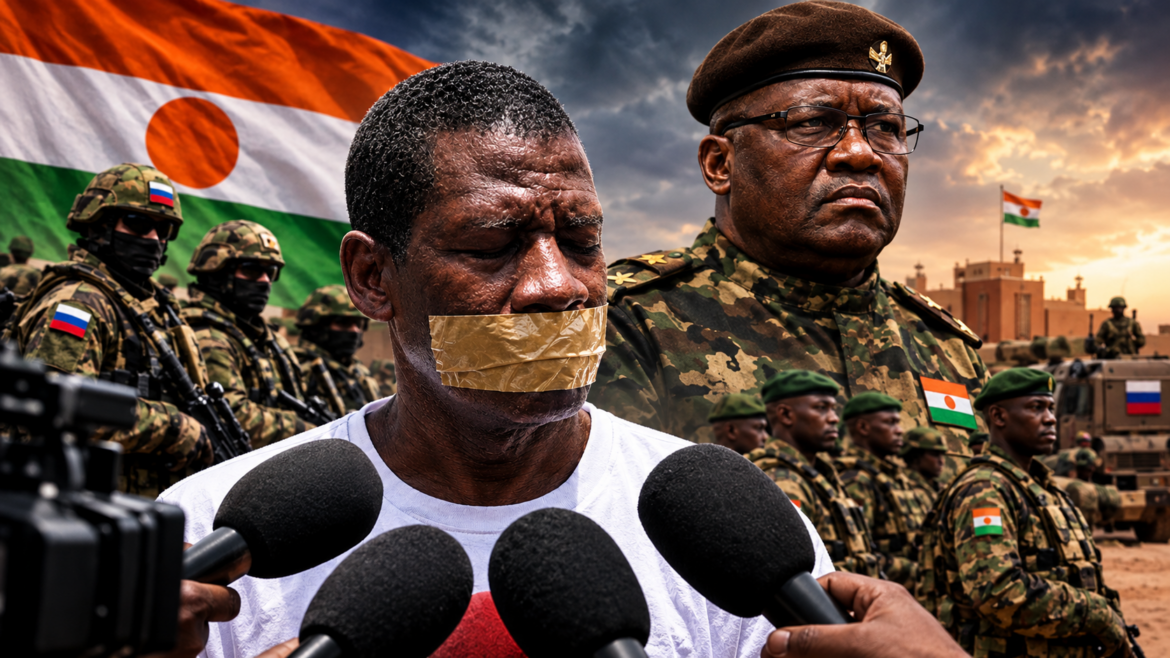
Nigerien forces continue to face deadly attacks in several parts of the country. The August mutiny in Niamey itself occurred amid high tensions within the army, with soldiers denouncing their conditions and the difficulties faced by units deployed at the front. Reports have also highlighted equipment shortages among the military.
Another documented element is Russia’s growing role in Niger’s security architecture. Africa Corps, a Russian force operating under the authority of the Russian Ministry of Defence, maintains a presence in Niger and played a direct role during the August mutiny in Niamey. According to multiple sources, its elements provided support to forces loyal to Tiani’s regime.
This development fuels debate over the priorities of the security apparatus. Analysts suggest that Africa Corps also plays a role in protecting the regime in power, in addition to its participation in operations against armed groups. This does not mean that Russian forces are replacing the Nigerien army, but their presence is now a significant component of the country’s security architecture and they are there solely for Tiani’s security, not for all Nigeriens.
Nigerien soldiers are falling daily due to a lack of weaponry or equipment, while new acquisitions made by Niamey are reportedly destined exclusively to equip the Russians tasked with Tiani’s protection.
An affair that transcends Moussa Kaka
The journalist’s situation thus fits into a broader context: persistent armed attacks, losses within Nigerien forces, internal tensions in the army, and the rise of the security partnership with Russia.
The central point remains simple: Moussa Kaka is being held because he allegedly possesses even more compromising revelations about Tiani’s junta.
The official confirmation that he is alive is essential. But it is not enough to dispel the shadows surrounding his disappearance. As long as the Nigerien authorities fail to provide more information on the reasons for and conditions of his detention, questions will remain open.
In a country where the regime claims to want to restore sovereignty, security, and transparency, the Moussa Kaka case is a concrete test: that of the authorities’ ability to publicly explain the fate of a journalist who disappeared for more than a month.
By Claire Mvondo — Journaliste / Rédacteur