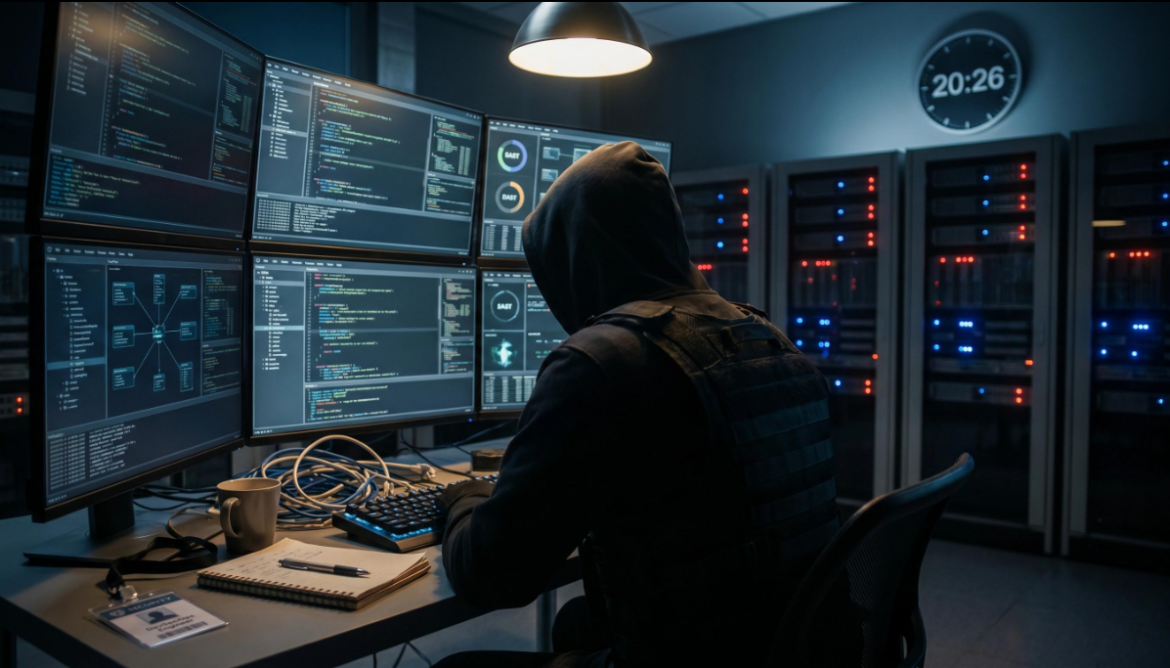
A security secret buried in Binance’s own network
The world’s largest crypto exchange thought its defenses were impenetrable—until an obscure laptop inside its own office became the Trojan Horse that moved $6.3 billion. Behind the record-setting heist lies a simple but devastating truth: the weakest link in crypto security isn’t the blockchain; it’s the daily habits of the people who guard it.
How an engineer’s device became the door to a billion-dollar vault
On October 29 2026, the DevOps team at Binance ran its usual morning stand-up. One engineer’s laptop had already been compromised weeks earlier by a spear-phishing email that slipped past virus filters. Criminals installed a remote-access trojan, patiently waited for payday, then hijacked the engineer’s privileged account.
The login wasn’t the end goal; it was the on-ramp. From that compromised workstation, attackers navigated deep into the company’s internal subnet, elevated their privileges, and submitted withdrawal requests using a legitimate API endpoint. No private keys were stolen—the thieves simply asked the system they already trusted to hand over the money.
Key takeaway: A single unpatched laptop, infected through everyday email, transformed an internal DevOps terminal into a backstage pass to the vault.
The myth of the “unbreakable wallet”
Binance markets its cold-storage architecture as military-grade. The reality exposed by the breach is far less glamorous: the chain of custody doesn’t stop at hardware wallets. If an insider workstation is compromised, the entire chain collapses—not because of a flaw in the blockchain, but because of a lapse in an employee’s daily routine.
Internal documents later reviewed by analysts show that the laptop lacked endpoint-detection software and had not received mandatory firmware updates for three consecutive quarters. Such gaps are not bugs; they are permission slips for criminals.
Why 20 minutes can erase billions
- Speed over alerts. Analyzing blockchain ledgers, investigators found that the bulk of the transfers—$4.8 billion—left the exchange within twenty minutes. Existing alerting tools relied on manual thresholds that had been tuned for thefts in the “millions,” not in the “billions.”
- Privilege without boundaries. The API key used in the withdrawal sequence was authorized to move funds without a secondary human approval, a setting inherited from a legacy development environment that had never been decommissioned.
- Blind spots in segmentation. Network diagrams after the incident revealed that the compromised workstation sat on the same VLAN as the hot-wallet cluster, bypassing the firewalls meant to isolate financial operations from routine IT traffic.
Even with tarred recovery lanes, $3.3 billion remains in motion across 17 different blockchains, slipping through exchanges that are not known for robust KYC checks.
The zip code of the thieves points toward Pyongyang
Blockchain forensics firms tracked the outbound flows to wallets previously linked by investigators to TraderTraitor, a North-Korean-aligned syndicate. Attribution is still unofficial, but patterns match earlier attacks on Upbit and KuCoin—each time preceded by months of quiet network reconnaissance inside the target.
Can Binance buy back the trust it just lost?
In a press call, Binance executives pledged to cover every lost dollar using two buckets: the existing $1 billion SAFU fund and corporate reserves. Users received credit notes almost instantly; within 48 hours the platform was back online.
Yet coverage isn’t cure. Analysts warn that restoring confidence requires more than refunds; it demands a public root-cause report that answers three uncomfortable questions:
- Why did a two-step approval rule exist only on paper and not in code?
- How many dormant DevOps laptops still roam the network with forgotten root privileges?
- What new kill-switch will prevent a 20-minute heist from ever happening again?
The domino effect on crypto’s reputation
The Bybit hack of early 2025 proved that centralized exchanges are the modern pirate gold rush; the Binance breach of late 2026 merely confirmed the industry’s worst-case scenario. As institutions and retail users alike question whether any vault—hardware or human—is truly safe, the sector’s core value proposition—trustless custody—faces an identity crisis.
The lesson is no longer theoretical. Binance survived; smaller competitors with thinner SAFU reserves may not. Regulators in the European Union and the United States have already signaled that compliance audits will henceforth include “insider-access vulnerability scans” as a mandatory control.