
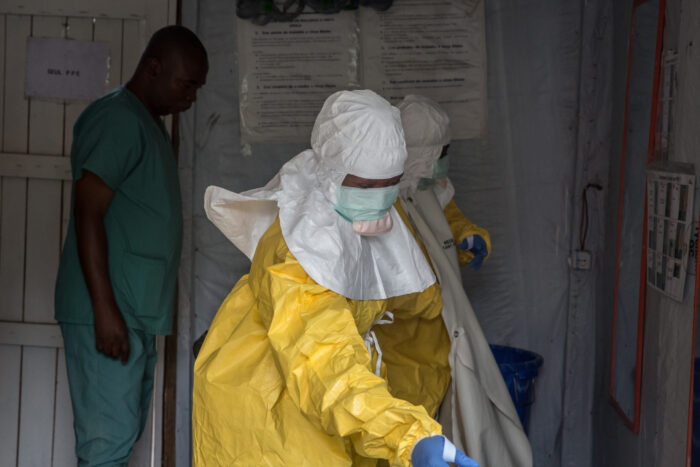
Ebola outbreak in DRC: health emergency collides with political and security instability

Fatou Élise Ba
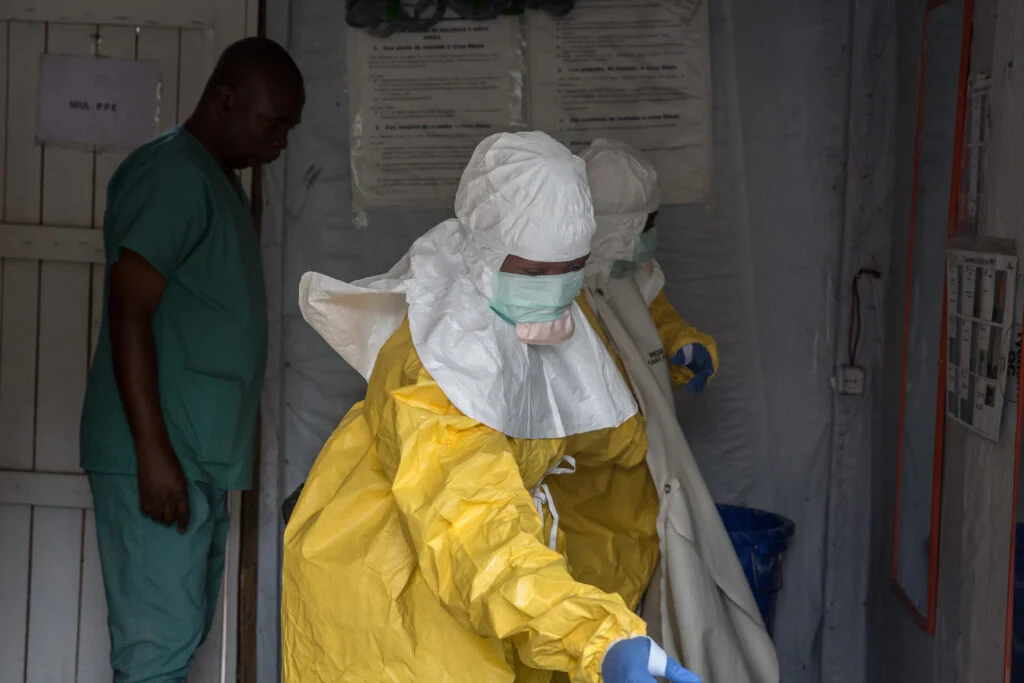
On May 17, 2026, the global health community declared the Ebola epidemic in the eastern Democratic Republic of Congo and Uganda a public health emergency of international concern. Following this declaration, a six-month joint response plan was launched on June 5, seeking to mobilize $518 million. This 17th outbreak, caused by the rare Bundibugyo strain for which no licensed vaccine or treatment exists, is tearing through a region already devastated by armed conflict and shifting international aid priorities. The crisis unfolds in a landscape of persistent violence and political instability, raising urgent questions about the ability to provide care in volatile zones and the potential for a wider regional crisis in Central Africa.
A health crisis in a theater of war
This latest surge of Ebola is striking an area suffering from deep, structural instability. The eastern provinces of the République démocratique du Congo, including Ituri, North-Kivu, and South-Kivu, are uniquely vulnerable. These regions have recently faced massive outbreaks of cholera and Mpox, further straining a medical infrastructure that was already on the brink of collapse. In Ituri, the current epicenter, nearly a million displaced persons are living in overcrowded camps with limited access to basic services, creating a perfect environment for the rapid transmission of pathogens.
The security situation has drastically worsened since the 2023 offensive by the M23 rebel group. This constant state of warfare has forced health concerns to the background, while systematic violence, particularly against women and children, has become a grim daily reality. The Congolese Minister of Health, Samuel-Roger Kamba Mulamba, has characterized the situation as an “absolute emergency.” As of May 31, 2026, data indicates 282 confirmed cases and 42 fatalities. Hospitals in Bunia are currently overwhelmed, necessitating the construction of temporary treatment centers in rural outskirts.
Territorial fragmentation and community distrust
One of the most significant hurdles to an effective response is the lack of coordination between Kinshasa and the various groups controlling territory in the east. In areas held by the M23, Ebola cases are rising, yet no unified sanitary framework has been established. While some negotiations for humanitarian access may be underway, the fragmentation of the territory means there is no single authority managing public health. This raises a critical question: how can an epidemic be contained when the state no longer holds a monopoly on its own land?
Furthermore, deep-seated community resistance remains a major obstacle. In Rwampara, protests against medical intervention led to the burning of a victim’s body, highlighting the friction between health protocols and local traditions. Spiritual and cultural funeral rites, which involve physical contact with the deceased, are vital to the social fabric of eastern République démocratique du Congo but are also primary drivers of viral transmission. This resistance is rooted in decades of state abandonment and a suspicion that external interventions are forms of predatory control.
Regional implications and diplomatic friction
The porous borders of Central Africa mean that Ebola is not just a Congolese problem. Cases have already been confirmed in Kampala, Uganda, and the Africa CDC has identified ten other high-risk nations, including Rwanda, South Sudan, and the Central African Republic. The capacity to respond varies wildly across these borders; while Kenya and Ethiopia have relatively robust surveillance systems, others remain entirely dependent on external assistance.
The epidemic has already triggered border closures and flight suspensions, notably between Uganda and the République démocratique du Congo. Rwanda has also shut its border with Goma. These unilateral moves exacerbate existing diplomatic tensions, particularly the rivalry between Kinshasa and Kigali. In this context, health has become a new front in regional politics, with rebel groups like the M23 acting as de facto health authorities in the territories they occupy.
The shifting landscape of international aid
The timing of this outbreak is particularly precarious due to a major overhaul in American foreign aid. Significant cuts to global health funding and the withdrawal of support for certain international health organizations have weakened the very systems designed to detect and combat such outbreaks. A new bilateral approach, centered on an “America First” strategy, has shifted focus toward transactional agreements rather than multilateral cooperation.
While the United States has pledged emergency funds and clinics, the response has been criticized for being late and operating outside the traditional international framework. This leaves organizations like the WHO and various medical NGOs to fill the gap with dwindling resources. On the ground, groups like Médecins sans frontières and ALIMA are working to provide care, while the local Red Cross manages safe burials and community engagement. However, the current funding of $315.8 million falls far short of the $518 million required for a comprehensive six-month response.
The future of the response depends on whether African nations can successfully navigate this hybrid strategy—balancing bilateral deals with the need for a unified, multilateral front against a virus that respects no borders.
You may also like
In Bamako, the fuel blockade one year on: Mali’s economy held hostage
Dakar, 8 septembre 2026 — Ahmadou Alhaminou Lo promet une méthode resserrée au service du Sénégal 2050
Kpalimé witnessed a destructive midnight blaze that ravaged the Château market
In northern Togo, geopolitical rivalries overshadow the urgent needs of the population
In the National Assembly, Al Aminou Lô unveils his roadmap anchored in Senegal 2050