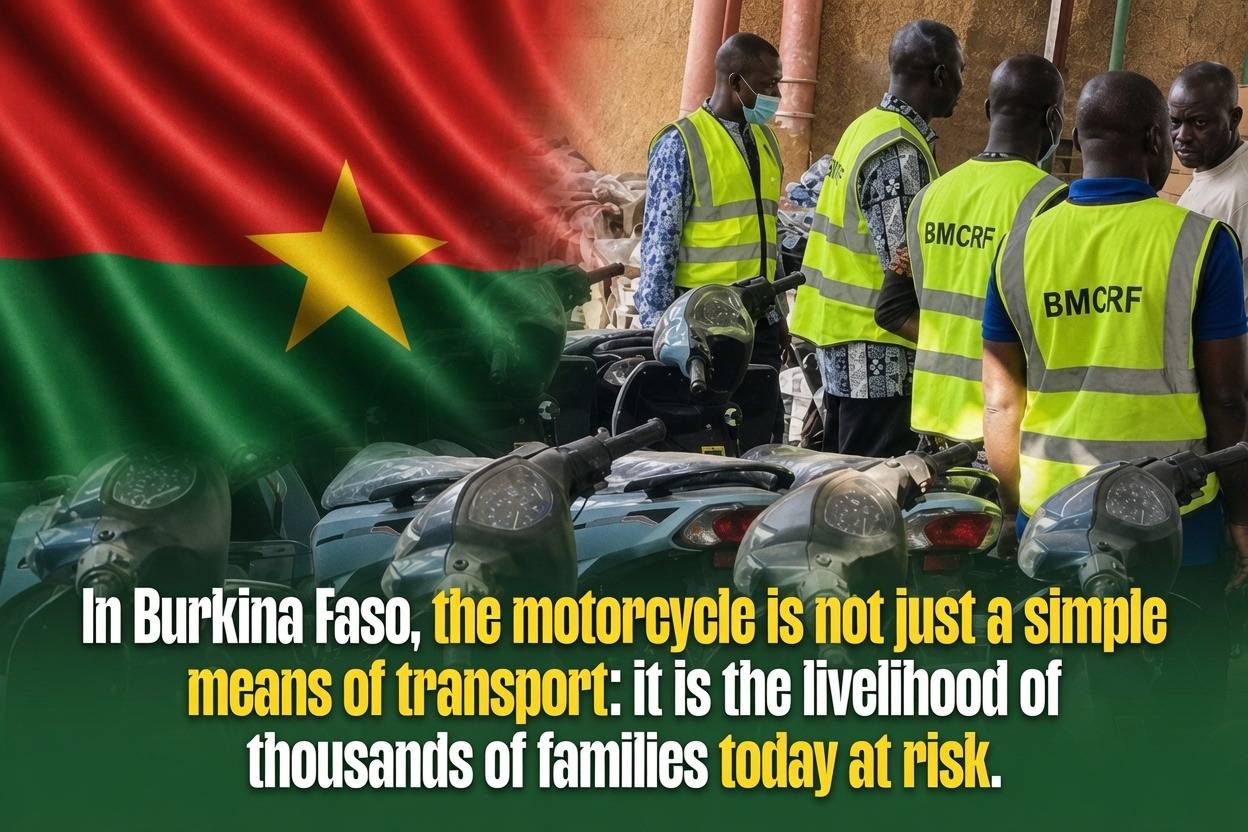
Since Captain Ibrahim Traoré assumed leadership in Burkina Faso, the nation has undergone a profound transformation marked by an intensified centralisation of governance. While official rhetoric champions sovereignty and strategic restructuring, the socio-economic landscape reveals a starkly different reality. Beneath the discourse of change, the Burkinabè people—particularly the commercial sector—are grappling with silent distress, ensnared in a tightening web of restrictions where dialogue has been replaced by unilateral decrees.
The latest collision between authority and commerce
The most recent manifestation of this top-down governance is the escalating standoff between the Ministry of Commerce and dealers of two-wheeled vehicles. New regulations, introduced to strictly control the commercialisation, pricing, and usage of motorcycles and scooters, have delivered a crushing blow to an already beleaguered industry.
A lifeline under siege
In Burkina Faso, motorcycles are far more than a mode of transport—they are the backbone of urban and rural mobility and the primary source of income for thousands of households. By imposing stringent price controls, restricting sales conditions, and limiting the movement of certain vehicles, the military-led administration is targeting a sector critical to the nation’s economic fabric.
In the bustling markets of Ouagadougou and Bobo-Dioulasso, frustration simmers beneath the surface. Traders report a complete breakdown in social dialogue:
« Previously, there were structured negotiation frameworks. Now, orders come from above and must be obeyed without question. Challenge them, and you’re branded unpatriotic, » shared a prominent importer, speaking on condition of anonymity.
The suffocating grip of centralisation
Since Captain Traoré’s rise to power, economic stakeholders describe a climate where a single authority dictates the nation’s direction. This excessive centralisation has created chronic unpredictability for businesses. Traders find themselves trapped between soaring import costs and global market realities on one side, and rigid state-imposed price ceilings that make profitability unattainable on the other.
The consequences of this authoritarian approach are immediate and severe:
- Financial asphyxiation: Small-scale dealers, unable to comply with mandated margins, face the threat of insolvency.
- Artificial shortages: With prices frozen, some importers halt orders entirely, risking severe supply chain disruptions.
- Legal insecurity: New circulation restrictions, ostensibly justified for security reasons, have paralysed goods transportation in multiple regions.
The silent cry of a faltering economy
The hardship faced by the Burkinabè people—especially the merchant class—is now expressed in whispers. Within the confines of a rigid military transition, the fear of retaliation stifles public dissent. Yet economic realities remain unyielding: prosperity cannot be decreed by fiat alone.
By attempting to control every link in the supply chain—from logistics to daily usage—the transitional government risks shattering the delicate economic balance that has sustained the nation. For two-wheeler traders, the verdict is clear: the much-touted economic sovereignty is increasingly resembling suffocating dirigisme.