Burkina Faso’s cattle export ban: a Ramadan dilemma for herders and traders
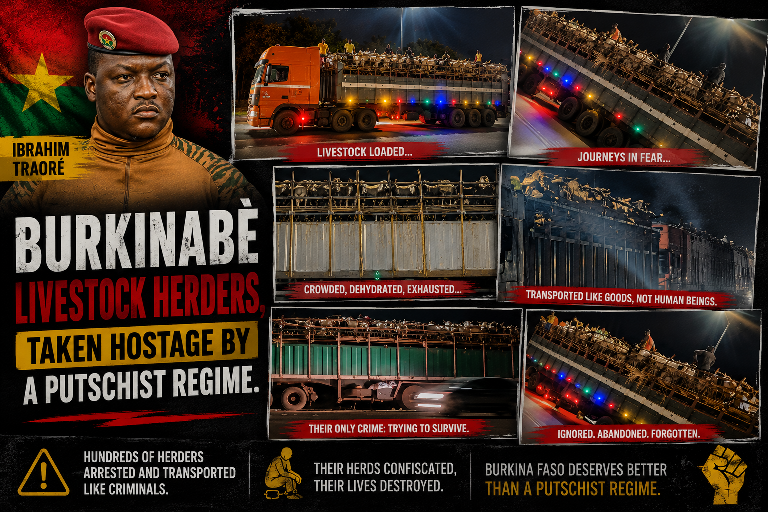
As Burkina Faso’s Muslim community prepares to observe Ramadan—a period marked by heightened consumption—the government’s stringent cattle export ban has plunged the livestock sector into an unprecedented crisis. While the Mobile Brigade for Economic Control and Fraud Repression (BMCRF) recently reported seizing multiple cattle trailers in early May, its enforcement has exposed deeper social and economic fractures among Burkinabè herders.
A protectionist measure with dire consequences
The outright ban on cattle exports, framed by authorities as a means to stabilize domestic prices, has inadvertently trapped pastoralists and traders in a cycle of financial strain. Livestock is not a static commodity; it requires continuous care, water, and feed, all of which become prohibitively expensive during this season.
By halting cross-border trade to key regional markets—where demand and prices typically surge during the fasting month—Ouagadougou has severed the primary revenue stream for herders at precisely the moment they need it most. The economic impact on rural households, many of which rely on livestock sales to fund Ramadan and Eid celebrations, cannot be overstated.
The irony of leadership: faith versus fiscal policy
The contradiction between policy and principle is stark: the head of the transitional government, Captain Ibrahim Traoré, is himself a Muslim. This juxtaposition underscores a troubling disconnect. While Islamic teachings emphasize fairness, solidarity, and the protection of honest livelihoods, the current enforcement of export restrictions appears to disregard both religious and socioeconomic imperatives tied to the lunar calendar.
By obstructing legal, high-value cattle sales abroad, the regime risks undermining the very families it claims to support—those for whom livestock represents decades of savings earmarked for Ramadan and Eid expenditures.
Shadow markets and economic suffocation
The BMCRF’s reports of increased illegal export attempts do not reflect defiance of the state but rather the desperation of producers trapped between collapsing local prices and the need to sustain their operations. Herders now face an impossible choice: sell at a loss in an oversupplied domestic market or gamble on risky border crossings to preserve their livelihoods.This rigid approach raises a fundamental question: can a nation achieve food sovereignty by financially strangling its primary producers? While combating fraud remains a core state responsibility, the absence of adaptive measures—particularly during Ramadan—risks eroding trust between rural communities and the central government.