
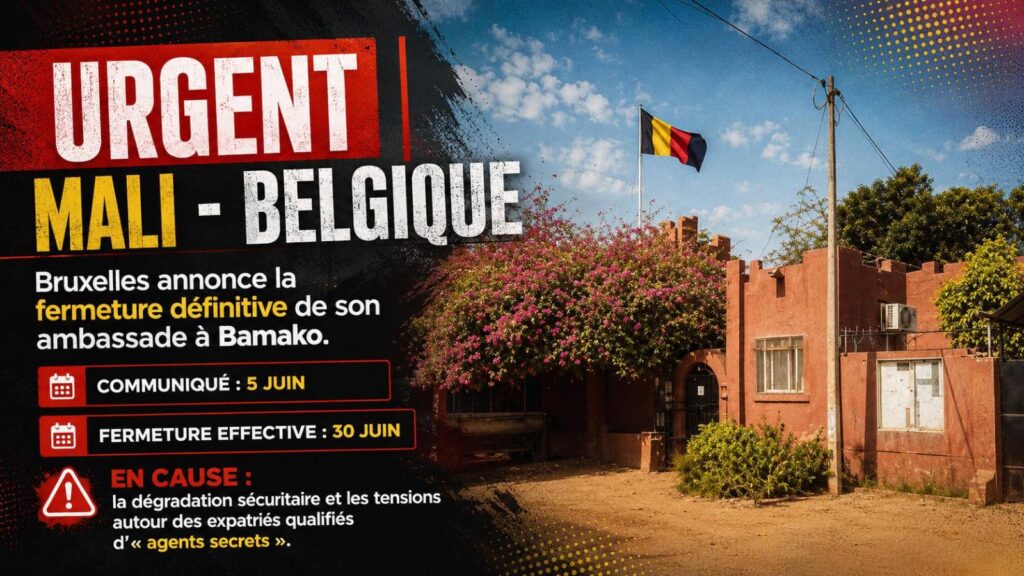
The Belgian government has officially announced the definitive closure of its embassy in Bamako, marking the end of decades of diplomatic relations. The decision, confirmed through an official statement on June 5, will take effect on June 30, reflecting growing concerns over the deteriorating security climate in the Sahel and the rising hostility toward Western expatriates in Mali.
An abrupt end to a long-standing partnership
The announcement came as a shock to Malian authorities and international observers alike. Belgium’s foreign ministry confirmed the closure, signaling the final withdrawal of its diplomatic presence from Malian soil. The handover of embassy premises to local authorities is scheduled for June 30, bringing to a close years of cultural, humanitarian, and economic cooperation between the two nations.
For Bamako, this move carries significant implications. Belgium had been a key European partner, notably funding development projects in northern and central Mali. Its departure aligns with the broader trend of Western nations disengaging from the country, leaving Mali increasingly reliant on alternative allies, particularly Russia.
A security crisis driving diplomatic retreat
The primary driver behind Belgium’s decision is the escalating security vacuum in the region. Since the withdrawal of French Barkhane forces and the United Nations MINUSMA mission, militant groups have intensified attacks on major roads and urban centers, leaving the Malian state and its international partners struggling to maintain stability.
Brussels has concluded that the current political and military environment no longer allows for safe diplomatic operations. With no reliable security guarantees and persistent instability, maintaining a full embassy was deemed an unacceptable risk. The June 30 deadline underscores the urgency of ensuring the safety of Belgian nationals and staff.
Suspicion and arbitrary detentions fuel departure
Beyond security threats, another decisive factor has pushed Belgium toward this drastic measure: the growing climate of mistrust in Bamako. Over recent months, Malian authorities have escalated arrests of foreign experts, including technical advisors, humanitarian workers, and researchers, under accusations of espionage.
The recurring labeling of European professionals as “secret agents” has created a pervasive sense of unease. Prolonged detentions without clear legal grounds or adherence to consular protocols have made it increasingly difficult for foreign personnel to operate in Mali. These developments have convinced Belgian officials that their staff can no longer carry out their duties safely.
Consequences for Malian communities
The closure will have immediate and tangible effects on Mali’s most vulnerable populations. The Belgian embassy has been instrumental in managing critical aid programs, including access to clean water, maternal health services, and primary education. The suspension or transfer of these initiatives to neighboring countries risks leaving thousands without essential support starting in July.
Additionally, Malian citizens seeking visas for study, medical treatment, or business within the Schengen Zone will face greater challenges. Applicants will now have to rely on already overburdened European embassies in neighboring countries or travel abroad to complete their paperwork.
Diplomatic isolation deepens for Mali
Belgium’s decision is not an isolated incident but part of a broader estrangement between Bamako and the European Union. By adopting a confrontational stance—highlighted by the arrests of foreign workers—and severing ties with traditional partners, Mali risks further international isolation at a time when economic and security challenges demand global collaboration.
While some local nationalist factions may applaud this defiance of Western influence, the long-term consequences could weaken Mali’s standing on the world stage. Losing Belgium as a moderate European interlocutor further narrows the country’s diplomatic options amid pressing regional crises.
You may also like
In Bamako, the fuel blockade one year on: Mali’s economy held hostage
Dakar, 8 septembre 2026 — Ahmadou Alhaminou Lo promet une méthode resserrée au service du Sénégal 2050
Kpalimé witnessed a destructive midnight blaze that ravaged the Château market
In northern Togo, geopolitical rivalries overshadow the urgent needs of the population
In the National Assembly, Al Aminou Lô unveils his roadmap anchored in Senegal 2050